


AI Agents VS AI Chatbots: How do they differ?
What are AI Agents?
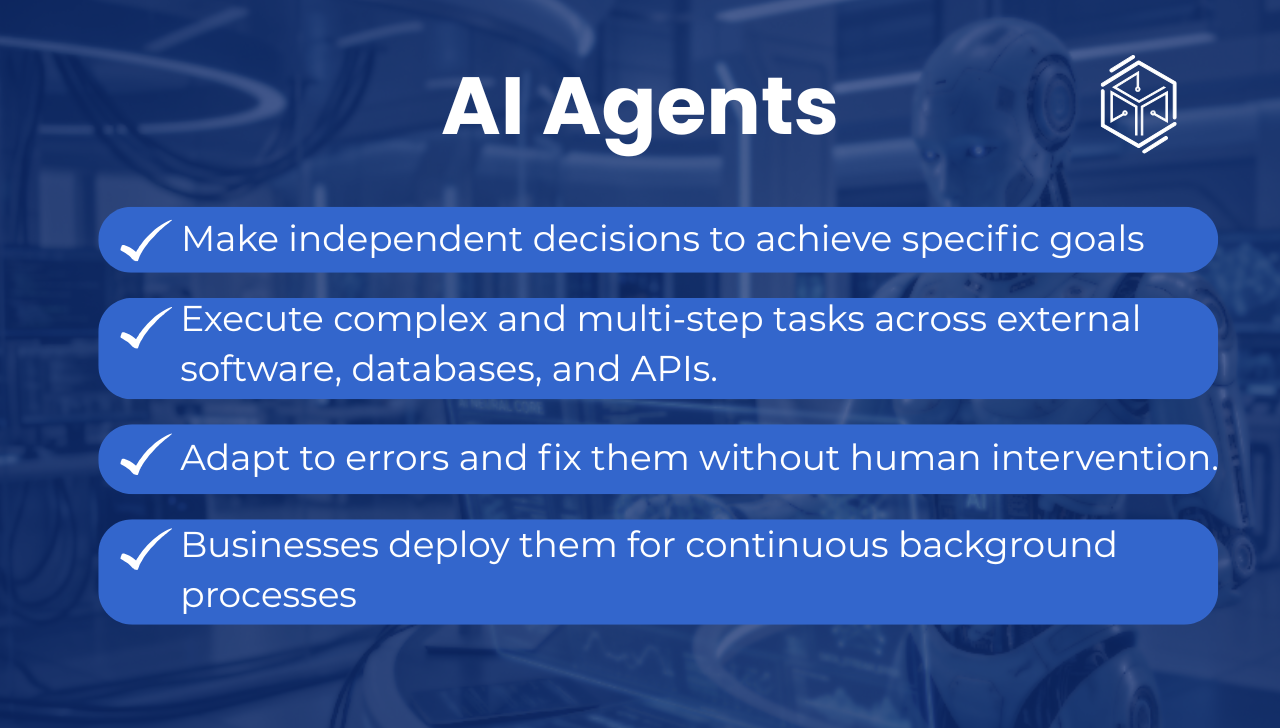
An AI agent is a software system designed to perceive its environment, make decisions based on that perception, and execute specific actions to achieve a predefined goal. These systems operate with a high degree of autonomy. They do not merely process text, they interact with external systems, databases, and APIs to complete complex, multi-step tasks.
The architecture of an AI agent typically includes sensors to receive input, a processing unit to determine the correct sequence of actions, and actuators or outputs to execute those actions. When a user assigns an objective, the agent breaks the objective down into smaller, sequential steps. It executes the first step, evaluates the result, and uses that feedback to determine the next necessary action.
This continuous feedback loop allows AI agents to handle dynamic situations. If an agent encounters an error while executing a task, it can register the error, alter its strategy, and attempt a different method without requiring further human intervention. They are built to read data, write data, and modify the state of the digital environments they operate within.
What are AI Chatbots?
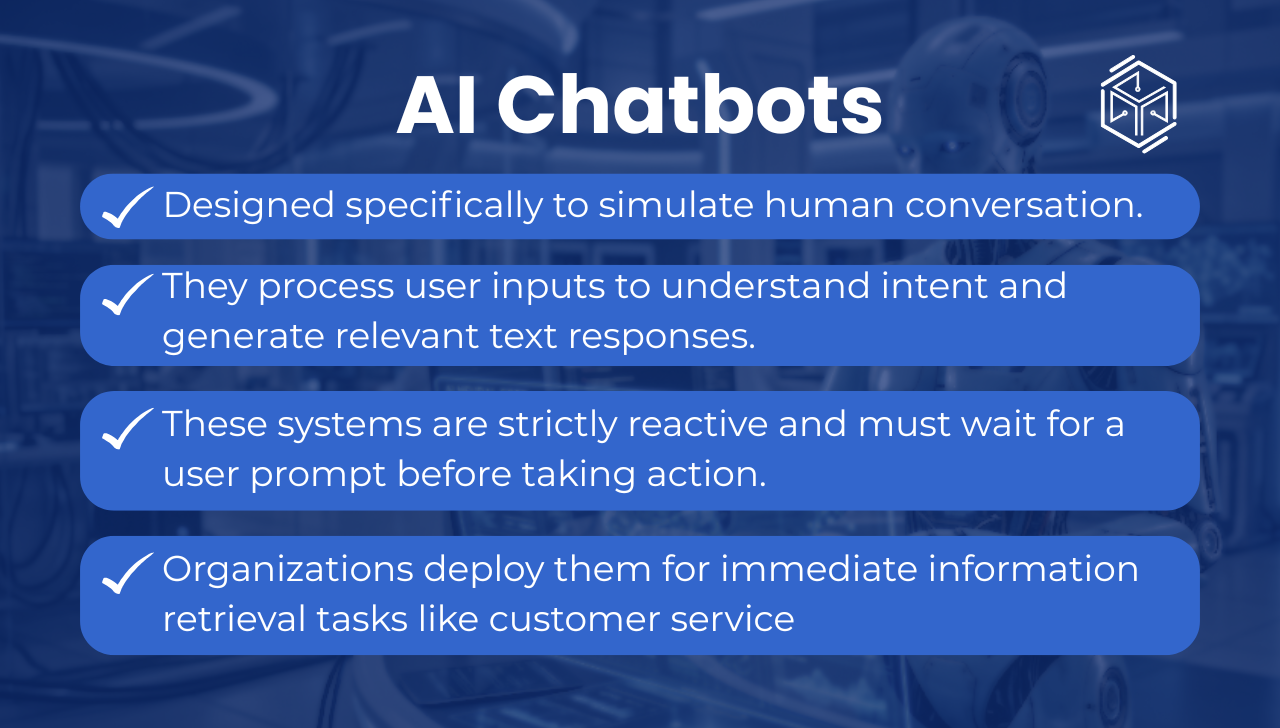
An AI chatbot is a software application designed to simulate human conversation through text or voice interfaces. The primary function of a chatbot is to receive user input, process the language to understand the intent, and generate a relevant textual response. Modern AI chatbots utilize Natural Language Processing (NLP) and Large Language Models (LLMs) to construct grammatically correct and contextually relevant replies.
Chatbots operate on a reactive model. They require a user prompt to function and do not initiate actions independently. When a user submits a question, the chatbot analyzes the keywords and sentence structure, references its training data or an attached knowledge base, and formulates an answer. Once the answer is delivered, the chatbot waits for the next user input.
While advanced chatbots can maintain the context of an ongoing conversation, their capabilities are generally restricted to the conversational interface. They are primarily read-only systems. A standard AI chatbot can inform a user about a process, explain a concept, or summarize a document, but it cannot log into a separate software platform and execute a process on the user's behalf.
What is the difference between AI Agents and AI chatbots?
The fundamental difference between AI agents and AI chatbots lies in their degree of autonomy and their capacity to execute actions outside of a chat interface.
AI chatbots are conversational interfaces restricted to text processing and generation.
AI agents are autonomous operators capable of utilizing external digital tools to execute tasks. To clarify these distinctions, the table below outlines the specific technical and operational differences.
|
Feature |
AI Chatbot |
AI Agent |
|
Primary Function |
Conversational response generation. |
Autonomous task execution. |
|
Operational Mode |
Reactive (requires user prompts). |
Proactive (works towards a goal independently). |
|
Tool Integration |
Limited (mostly read-only access to knowledge bases). |
Extensive (read/write access to APIs, databases, software). |
|
Output Type |
Text, code, or conversational audio. |
System actions, file modifications, data transactions. |
|
Error Handling |
Apologizes or provides a general text output when confused. |
Registers the error and attempts an alternative technical pathway. |
|
Execution Duration |
Immediate (turn-by-turn conversation). |
Extended (can run background processes for hours or days). |
When a user interacts with a chatbot, the transaction ends when the text is generated. When a user interacts with an AI agent, the user is issuing a directive. The agent will continue to process logic, query databases, and operate software applications until the directive is complete.
Use Cases of an AI Agent
AI agents are deployed in environments that require continuous monitoring, complex decision-making, and direct system interaction.
Autonomous Data Analysis and Reporting
An AI agent can be connected directly to a company's SQL database and analytics platforms. A user can instruct the agent to monitor specific performance metrics. The agent will autonomously query the database at scheduled intervals, analyze the output data for statistical anomalies, format the findings into a structured report, and distribute that report via email to the relevant stakeholders.
IT Infrastructure Management
In network operations, AI agents monitor system health parameters. If a server experiences an unexpected spike in processing load, the agent detects the anomaly. Instead of merely alerting a human, the agent can execute predefined scripts to allocate additional server resources, restart stalled services, or redirect traffic to backup servers, thereby resolving the issue without human intervention.
Automated Supply Chain Adjustments
AI agents can integrate with enterprise resource planning (ERP) systems. The agent can monitor real-time inventory levels, current sales velocity, and external supplier pricing APIs. When inventory drops below a calculated threshold, the agent can autonomously draft a purchase order, select the vendor with the lowest current price, and submit the order for fulfillment.
Use Cases of an AI Chatbot
AI chatbots are highly effective for functions requiring immediate information retrieval, user guidance, and conversational interactions.
Customer Service
Businesses deploy AI chatbots on their websites to handle high volumes of routine inquiries. Chatbots process user questions regarding store hours, return policies, or order statuses. By answering these standardized questions instantly, the chatbot prevents users from waiting in service queues and reduces the total ticket volume for human customer service representatives.
Internal Employee Knowledge Retrieval
Large organizations utilize AI chatbots as internal search interfaces. Employees can ask the chatbot specific questions about human resources policies, technical documentation, or compliance regulations. The chatbot scans the internal corporate documents and returns the exact paragraph or summary the employee needs, eliminating the time spent manually navigating complex company intranets.
User Onboarding and Application Navigation
Software companies integrate AI chatbots directly into their user interfaces. When a new user logs into a complex software platform, they can ask the chatbot how to locate a specific feature. The chatbot provides step-by-step text instructions or generates direct links to the necessary menus, assisting the user in learning the software layout quickly.
How Do Businesses Choose Between an AI Chatbot and an AI Agent?
Choosing between these two technologies requires a strict assessment of the business objective, the technical infrastructure, and the acceptable level of operational risk.
1. Assess the Core Objective: If the goal is to provide fast answers to users, improve search functions, or maintain engagement on a website, an AI chatbot is the correct deployment. If the goal is to reduce manual data entry, automate cross-platform workflows, or manage background processes, an AI agent is necessary.
2. Evaluate Infrastructure Readiness: AI agents require robust, well-documented APIs to function effectively. If a business operates on legacy software without accessible endpoints, an AI agent cannot interact with the system. Chatbots have lower infrastructure requirements, as they primarily need a text interface and access to text-based data files.
3. Determine Security and Risk Tolerance: Because AI agents have write access to systems, they carry higher operational risks. An incorrectly configured agent could autonomously delete data or send erroneous emails to clients. Businesses must implement strict permission controls and testing environments before deploying agents. Chatbots, being primarily read-only, carry lower operational risks and are safer for immediate deployment.
Can an AI Chatbot Be Upgraded into an AI Agent?
A standard AI chatbot cannot organically evolve into an AI agent, but developers can upgrade the underlying architecture of a conversational model to grant it agentic capabilities. This process is known as enabling "tool use" or "function calling."
To upgrade a chatbot, developers must explicitly program the AI model to recognize when it needs external information. Instead of forcing the model to generate an answer based purely on its training data, the developers provide the model with a list of available external functions, such as "search the web," "query a database," or "send an API request."
When the upgraded AI receives a user prompt, it assesses whether the prompt can be answered directly or if it requires a tool. If a tool is required, the AI halts text generation, writes the necessary code to activate the tool, retrieves the external data, and then uses that newly acquired data to formulate the final response. By adding multi-step reasoning frameworks and API access, developers successfully convert a reactive conversational chatbot into a proactive, task-executing AI agent.
.jpg)


