AI Engineer vs ML Engineer: The Definitive 2026 Career Guide
Table of Contents
- The Current Landscape
- The Main Difference between an AI Engineer and a ML Engineer
- Core Responsibilities and Technical Skill Set
- AI Tools and Technologies Shaping the Field in 2026
- Navigating AI Ethics and Risks in Your Engineering Career
- Making the Choice Between AI Engineering and ML Engineering
- Frequently Asked Questions
The Current Landscape of Artificial Intelligence and Machine Learning in 2026
The technological industry of 2026 offers distinct career options within the domain of automated systems and advanced computation.
Specifically, the roles of AI Engineer and ML Engineer have differentiated significantly over the past few years. For professionals consulting educational platforms like BigBlue Data Academy to determine their career specialization, understanding this differentiation is necessary.
Artificial Intelligence (AI) and Machine Learning are related fields, yet they demand distinct technical competencies and focus on different operational outcomes. Artificial intelligence (AI) is a transformative technology that enables machines to perform tasks that typically require human intelligence, with broad applications across industries such as healthcare, finance, logistics, and more. Machine learning forms a specific category of artificial intelligence, concentrating primarily on the development of algorithms that parse data, identify patterns, and generate predictions without explicit programmed instructions for every scenario. Understanding core machine learning concepts is foundational to distinguishing between the responsibilities of AI engineers and ML engineers. Artificial intelligence encompasses a broader scope, integrating machine learning models, natural language processing routines, computer vision, and logic systems to construct applications that execute complex cognitive tasks autonomously. Science fiction has long influenced public perceptions of AI, often depicting artificial beings and exploring themes of sentience and existential risk. While most current AI systems are considered narrow AI, focused on specific tasks, the broader goal of AI research is to achieve human intelligence in machines, enabling them to reason, understand, and solve problems across diverse domains.
As the software industry has matured by 2026, companies require specialists who can either construct the foundational predictive models or integrate those models into large-scale, user-facing applications. The AI boom accelerated after 2017 with the introduction of the transformer architecture, which significantly improved deep learning capabilities. Deep learning is a subset of machine learning that uses multilayered neural networks to simulate the complex decision-making power of the human brain, drawing inspiration from the structure and function of the human brain itself. The prevalence of generative AI tools has increased dramatically in the 2020s. Generative AI is a subfield of artificial intelligence that uses generative models to create text, images, videos, audio, software code, or other forms of data. Generative AI applications include chatbots, text-to-image models, and text-to-video models. Generative AI's ability to create and modify content has led to several unintended consequences and harms. AI’s ability to process vast amounts of data, learn from it, and automate repetitive tasks has enhanced efficiency and freed human workers for more complex responsibilities. AI's ability to analyze and interpret large datasets also raises important ethical and privacy considerations, as it enables surveillance and data analysis capabilities that must be managed responsibly. AI systems learn and improve through exposure to vast amounts of data, identifying patterns and relationships that humans might miss. AI is also used in optical character recognition (OCR) to pull text and data from various images and documents, transforming unstructured content into structured, business-ready data. Robotics and automation are significant applications of AI, allowing machines to perform tasks autonomously in various industries. The AI industry is transforming sectors such as healthcare, finance, and logistics by improving efficiency and decision-making at an unprecedented pace. AI technologies enable coordination of sensors and effectors, threat detection and identification, marking of enemy positions, and target acquisition in military applications.
This article provides a detailed examination of both professions, defining their precise requirements, daily responsibilities, and expected outcomes. By examining the specific tools, programming languages, and deployment strategies associated with each role, professionals can make an informed decision regarding their educational and career investments in the data sector. For those seeking advanced roles or leadership positions, a master’s degree in Artificial Intelligence offers a key qualification and competitive edge, as both AI and ML roles require strong programming and software engineering foundations and often overlap in industry roles. Both AI engineers and ML engineers require strong programming skills, particularly in Python, Java, C++, and R. If an individual prefers rapid prototyping with existing tools, the AI Engineer path is faster to enter compared to ML Engineering, which involves deeper technical specialization. Data analysis and visualization are essential skills for AI professionals, as they help in interpreting and presenting data effectively. Programming is a fundamental skill for any AI professional, with Python being widely used for AI model development due to its simplicity and extensive library support. Natural language processing enables machines to interact with human language, making it a critical skill for AI applications like chatbots and virtual assistants. AI professionals must understand cutting-edge technologies while also possessing the ability to apply them effectively in various industries. The choice between these two options depends entirely on an individual’s preference for mathematical optimization versus software integration and system design. Hands-on experience through internships and personal projects is also crucial for applying knowledge in practical settings and achieving success in AI careers.
The main difference between an AI Engineer and a ML Engineer

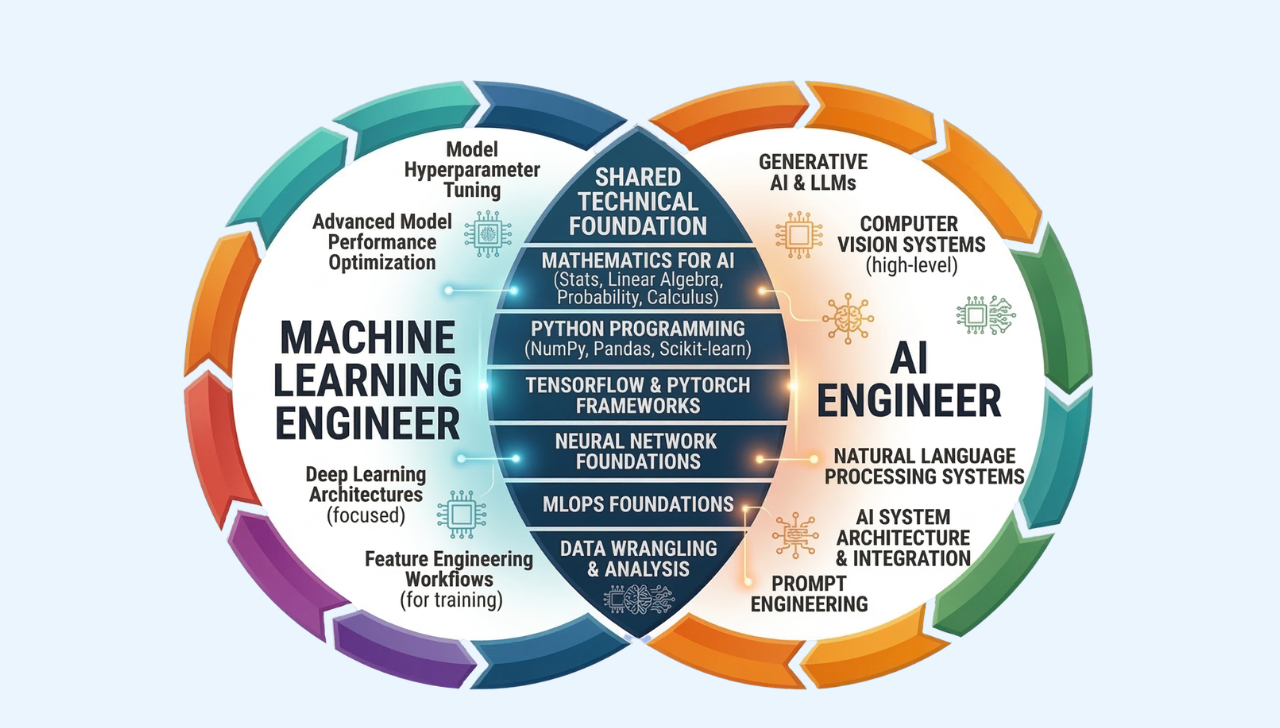
The distinction between these two engineering roles becomes most apparent when analyzing their respective project scopes and deployment methodologies. The roles of AI Engineers and ML Engineers differ significantly in their daily focus and the complexity of tasks they handle.
A Machine Learning Engineer typically receives a specific, constrained problem, such as increasing the precision of a fraud detection algorithm by three percent. Their scope is highly constrained and intensely focused on mathematical optimization and data processing efficiency. The output of their work is usually a serialized model file or a specific microservice dedicated solely to generating predictions based on input variables. ML Engineers are model-focused and work at the model layer, while AI Engineers are product-focused and work at the application layer. Deploying machine learning models and model deployment are key tasks for ML Engineers, often involving integrating trained models into existing systems and utilizing cloud platforms, containerization tools like Docker and Kubernetes, and MLOps practices to deploy, scale, and monitor models in production environments.
An AI Engineer handles a broader, more systemic scope. They might receive a directive to develop a fully functional customer support application that utilizes text generation, speech recognition, and database querying. Their output is a complete, deployable software application that features user interfaces and database connections. AI Engineers create applications that focus on unstructured data, while ML Engineers build models using structured data. Regarding deployment, Machine Learning Engineers concentrate on the infrastructure required to serve the model, ensuring the hardware accelerators, such as Graphics Processing Units, are utilized effectively during inference.
AI Engineers concentrate on the infrastructure of the entire application, managing the deployment of web servers, database clusters, and the routing of network traffic. In daily operations, the ML Engineer spends the majority of their time analyzing data distributions, testing different mathematical loss functions, and waiting for model training processes to complete. The Artificial Intelligence Engineer spends their time writing application logic, testing application programming interface endpoints, and debugging the data flow between different software components within the application architecture.
The Core Responsibilities and Technical Skill Set of a Machine Learning Engineer

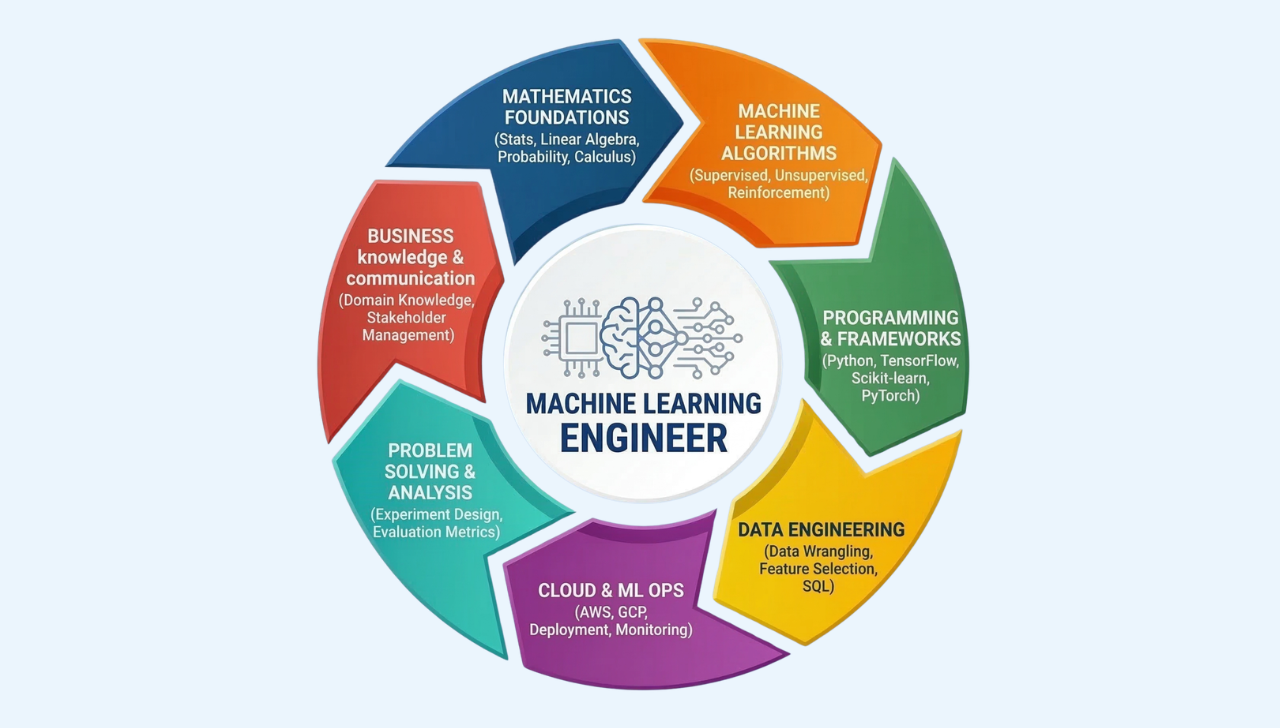
A ML Engineer focuses primarily on the design, training, optimization, and deployment of predictive models.
The daily operations involve extensive interaction with large datasets, requiring a high degree of mathematical proficiency, specifically in linear algebra, calculus, and statistical probability. Professionals in this role utilize programming languages such as Python or C++, alongside specialized frameworks including PyTorch, TensorFlow, and Scikit-Learn. A strong understanding of data structures is essential for optimizing algorithms and ensuring model performance and scalability.
The primary objective is to improve the accuracy and efficiency of algorithms that process numerical, categorical, or unstructured data. A significant portion of the workflow consists of data preprocessing, feature engineering, and hyperparameter tuning. Deep learning, a subset of machine learning, uses advanced neural networks—such as artificial neural networks and deep neural networks—to solve complex problems. An artificial neural network is a layered architecture inspired by the human brain, designed for pattern recognition and learning through algorithms like backpropagation. Deep neural networks, which consist of multiple hidden layers, enable the modeling of complex patterns and are foundational in advanced AI systems such as generative AI and computer vision. Mastery of architectures like convolutional neural networks (CNNs) is critical for applications including autonomous vehicles, facial recognition, generative AI, computer vision, and natural language processing.
When a model achieves the required accuracy metrics, the Machine Learning Engineer must deploy it into a production environment, ensuring it can process incoming data efficiently. This deployment phase often requires knowledge of cloud computing platforms, containerization tools like Docker, and orchestration systems like Kubernetes to manage the computational resources required for model inference. Google Cloud is a leading platform for deploying machine learning models, offering scalable infrastructure and tools for AI and ML solutions. Training and deploying advanced models, especially deep neural networks, often demands significant computing power, which is typically provided by cloud platforms and large-scale data centers.
Furthermore, Machine Learning Engineers must continuously monitor the performance of deployed models to detect performance degradation over time, a phenomenon known as data drift, and retrain the models with updated datasets when necessary. They collaborate closely with Data Scientists who conduct the initial exploratory data analysis and Data Engineers who manage the data storage infrastructure. The role requires a deep understanding of computer science principles to ensure the models execute computations rapidly and do not exceed memory constraints within the production servers.
The Core Responsibilities and Technical Skill Set of an Artificial Intelligence Engineer

An AI Engineer operates within a different segment of software architecture, focusing on the integration of various cognitive services and pre-trained models to construct functional, autonomous applications. AI Engineers often integrate pre-trained models into applications, with a strong emphasis on product deployment and generative AI. Rather than creating algorithms from foundational mathematics, these professionals utilize existing machine learning models, LLMs and application programming interfaces to assemble complex software systems. They also manage the AI product lifecycle, including tasks such as API integration and prompting strategies, ensuring the successful deployment and operation of AI solutions.
In 2026, the toolset of an Artificial Intelligence Engineer heavily features prompt engineering frameworks, orchestration libraries like LangChain or LlamaIndex, and vector databases utilized for information retrieval tasks. AI Engineers are increasingly building intelligent systems capable of autonomous decision-making and adaptation to new scenarios. Components of AI applications often include ai agents—autonomous entities capable of perceiving their environment, making decisions, and executing actions independently, which are essential for complex, goal-oriented tasks.
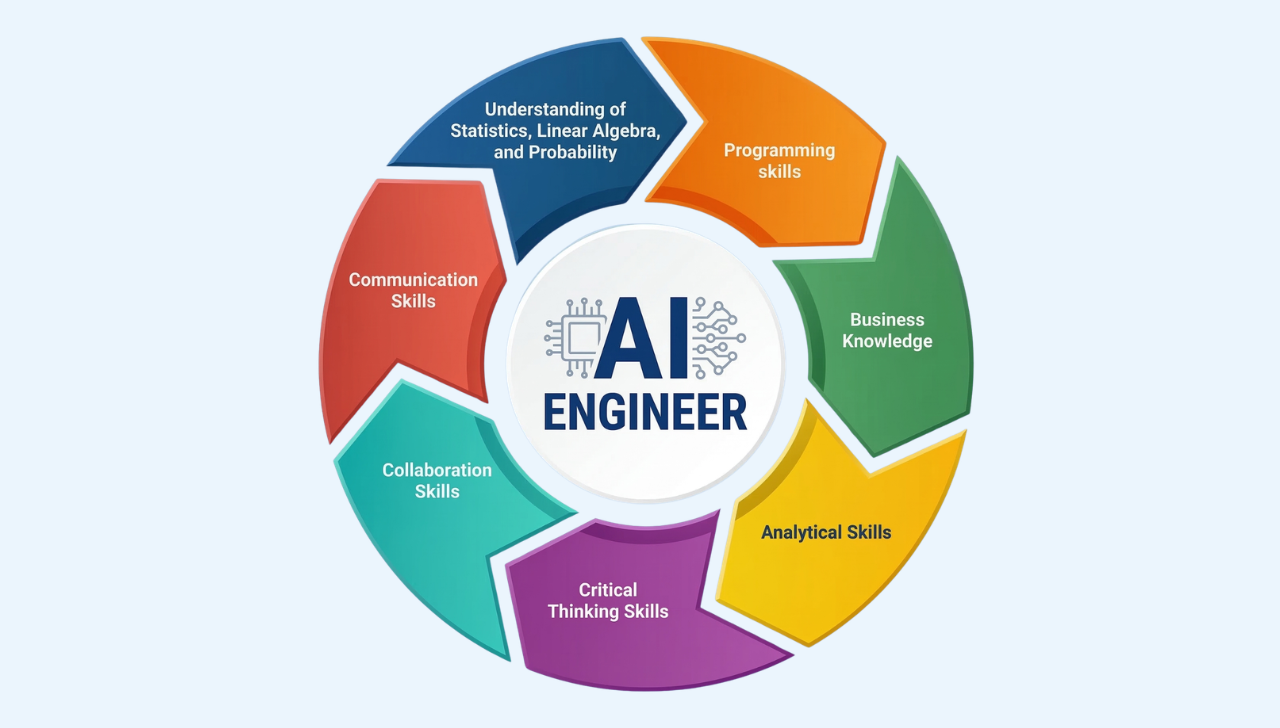
Read More: The 7 Essential Skills for AI Engineers
The required technical skills include robust software engineering fundamentals, proficiency in back-end development languages such as Python, JavaScript, or Go, and a thorough understanding of system architecture. AI Engineers need expertise in multiple AI technologies, including machine learning, deep learning, neural networks, robotics, and cognitive computing. The daily responsibilities involve connecting distinct application components, ensuring secure data transfer between interfaces and artificial intelligence models, and managing the latency of system responses.
AI Engineers are responsible for designing the logic that dictates how an application interprets user input, queries the appropriate models, synthesizes the returned data, and presents the final output to the user. This includes designing and refining the algorithms that power ai systems, which is crucial for ensuring AI performance and scalability. They must also implement security protocols to prevent malicious exploitation of the models and ensure compliance with data privacy regulations. Their work requires continuous evaluation of different application programming interfaces to determine which external model provides the optimal ratio of response speed, accuracy, and computational cost for a specific application feature. The focus remains consistently on the final software product and the user interaction experience. Additionally, AI Engineers implement safeguards and monitor performance for AI products like chatbots and copilots to ensure reliability and safety.
An AI product manager plays a crucial role as the liaison between technical teams and business stakeholders, overseeing the entire AI product lifecycle and ensuring alignment with business goals for successful AI product development.
To summarize,
A Machine Learning Engineer’s main responsibilities include:
- Research to gain domain knowledge
- Model development by training and optimizing algorithms
- Cleaning and normalizing raw data
An AI Engineer on the other hand, takes an existing ML model either built by the ML Engineer or accessed by API’s like OpenAI. Yet, their responsibilities include:
- API Integration, which means connecting and integrating the LLM into the application
- Prompt Engineering
- Vector Databases and RAG systems
While an AI Engineer and a ML Engineer implement different tasks and responsibilities, they should and must have some common skills:
Strong Python knowledge: Python is the most used programming language when it comes to data science and Artificial Intelligence. Referring to python, excellent knowledge of Object-Oriented Programming is required by an AI Engineer and excellent knowledge of python libraries (such as pandas, numpy, sci-kit learn, tensorflow etc). Despite the fact that most of the libraries used are coded in C or C++
Statistics and Maths: The background behind AI and machine learning algorithms is only maths and statistics. Therefore, when the predictions results of a ML model are not realistic and they are wrong, the data scientist or the AI Engineer must be able to point out where the mistake is and correct it.
Artificial Neural Networks: ANNs are one of the most used tools of an AI Engineer as they need to understand how the context window and the tokenization work. Meanwhile, ML Engineers have to deal with Backpropagation and understand how the model learns.
Data Processing.
AI Tools and Technologies Shaping the Field in 2026
The landscape of artificial intelligence in 2026 is defined by a dynamic ecosystem of advanced AI tools and technologies that are transforming the way intelligent systems are built and deployed. AI models, including cutting-edge generative AI and deep learning architectures, are at the heart of modern AI systems, enabling machines to interpret visual data, generate human language, and make autonomous decisions in real-world applications.
Machine learning algorithms—ranging from supervised to unsupervised learning—are continually refined to improve model performance, allowing AI systems to learn from vast and diverse datasets. AI researchers are pushing the boundaries with neural networks, including sophisticated artificial neural networks, which empower AI to adapt and solve complex challenges across industries.
Key AI tools such as computer vision and natural language processing are now standard components in AI workflows, enabling systems to analyze data, interpret visual data, and generate human language with remarkable accuracy. These advancements are not only powering AI systems behind image and speech recognition, virtual assistants, and predictive analytics, but are also driving innovation in generative AI tools that can create new content and solutions autonomously.
As a result, AI applications in 2026 are more sophisticated than ever, leveraging the synergy between machine learning techniques, deep learning, and advanced data analysis to deliver intelligent, adaptive, and impactful solutions across sectors.
Navigating AI Ethics and Risks in Your Engineering Career
As artificial intelligence becomes deeply integrated into everyday life and business, AI engineers and professionals must prioritize AI ethics and risk management in every stage of AI development. The deployment of AI models and systems brings significant responsibility, as these technologies can influence decisions, impact individuals, and shape societal outcomes.
AI ethics demands that engineers ensure their AI systems are fair, accountable, and transparent. This means actively identifying and mitigating biases in training data, designing algorithms that do not discriminate against any group, and making the decision-making processes of AI systems understandable to users and stakeholders. Responsible AI development also involves ongoing monitoring to prevent unintended consequences and to ensure that AI models continue to operate as intended in changing environments.
AI professionals must also be vigilant about the potential risks associated with AI, including the misuse of AI systems for malicious purposes or the inadvertent harm they may cause. By embedding ethical considerations into every phase of AI development and deployment, engineers can help build trust in artificial intelligence and ensure that AI technologies are used to benefit society as a whole.
Making the Choice Between Artificial Intelligence Engineering and Machine Learning Engineering
|
|
AI Engineer |
ML Engineer |
|
Core Philosophy |
Applied Intelligence: Focuses on using models to solve business problems. |
Scientific Research: Focuses on creating and refining the models themselves. |
|
Primary Workflow |
Integrating LLMs, Prompt Engineering, and building AI-powered apps. |
Data preprocessing, feature engineering, and training algorithms. |
|
Technical Stack |
Python, APIs (OpenAI/Anthropic), Vector DBs, LangChain. |
Python, R, TensorFlow, Scikit-learn, Big Data tools (Spark). |
|
Math Requirement |
Practical: Statistics and logic for data flow and system evaluation. |
Heavy: Linear algebra, calculus, and probability for optimization. |
|
Key Output |
A functional AI feature or product (e.g., a smart chatbot). |
A high-performing model or predictive algorithm. |
Choosing the appropriate professional specialization in 2026 requires an objective evaluation of one’s technical strengths and work preferences. The demand for AI professionals is rapidly increasing, with job openings projected to grow significantly in the coming years, making this a promising time to pursue AI careers.
Individuals who possess a strong aptitude for advanced mathematics, statistics, and algorithm design will find the ML Engineer role highly suitable. ML Engineers typically have a deeper academic background in STEM, data science, or research. This option demands a rigorous analytical methodology and a high tolerance for iterative experimentation with data variables and mathematical functions. It is the optimal choice for professionals who derive satisfaction from improving the fundamental efficiency of computational processes and understanding the underlying mechanics of predictive algorithms.
Conversely, individuals who possess a strong background in traditional software development, system architecture, and product design will find the AI Engineer role more aligned with their skills. AI Engineers are often from a software engineering background. This option requires a pragmatic approach to problem-solving, focusing on the rapid assembly of functional software utilizing existing tools and application programming interfaces. It is the optimal choice for professionals who prioritize building complete applications and enjoy managing the interaction between various software systems.
Big Blue Data Academy provides educational resources and structured curricula designed to prepare professionals for both of these distinct specializations. Certifications from industry leaders can demonstrate commitment to mastering AI technologies and enhance job prospects in AI careers. Prospective students must assess whether they prefer to construct the internal mathematical logic of the models or construct the software applications that surround and utilize those models. Networking is also vital for advancing a career in AI, with opportunities available through conferences, workshops, and online communities.
Both roles offer significant demand in the current job market, but they require entirely different daily routines and technical methodologies to achieve success in the technology industry. The broad range of opportunities in AI careers makes this an exciting field for aspiring professionals.
Frequently Asked Questions
Q: Can I transition from a Software Engineer to an AI Engineer in 2026?
A: Absolutely. In 2026, the AI Engineer role is more aligned with software engineering than traditional data science. If you understand APIs, data flow, and "Agentic" workflows, you can transition faster here than into ML Engineering, which requires deeper mathematical foundations.
Q: Which role pays more in 2026?
A: Both roles are among the highest-paying in the 2026 tech landscape. While ML Engineers often see high rewards for deep technical specialization in model architecture and optimization, AI Engineers are seeing rapid salary growth due to their ability to quickly deploy high-impact, customer-facing solutions like autonomous agents.
Q: Do I need a Master’s degree for these roles?
A: While a Master’s degree was once the standard, the 2026 job market has shifted toward "Skills-First" hiring. Employers now prioritize a robust portfolio of live projects, industry-recognized certifications, and the ability to solve real-world problems.
Q: Is "Prompt Engineering" still a relevant skill for AI Engineers?
A: In 2026, "simple" prompting is a basic skill. Professional AI Engineers now focus on Prompt Chaining, Automated Evaluations (LLM-as-a-judge), and fine-tuning to ensure reliability in production environments.