


Black Friday in Greece: What the Data Reveals
Black Friday is almost here. We looked at 16 years of Google searches and official retail sales to see what the day really changes in Greece.
Black Friday Comes to Greece
Black Friday is the Friday after Thanksgiving in the US, or, in more Greek standards, the last Friday of November. Over there, it has long marked the start of the Christmas shopping season, with big discounts in every shop. Over the last decade, it has spread around the world, and Greece is no exception: every November, our inboxes fill up with offers and shop windows with "-50%" signs.
But does it really spike sales, or is it just the start of our common winter sales before Christmas? Is it a trend that actually worked for Greek retail stores, or just another imported US trend?
So when did Greeks start caring about it? Google searches give a pretty clear answer. Until 2015, almost nobody in Greece searched for "Black Friday". On Black Friday 2016, searches suddenly jumped, and that day still holds the record. Since then, searches on the day itself have fallen to about a third of the 2016 level.
That doesn't mean Greeks lost interest: over the whole of November, searches are still about 60% of their 2019 peak. They are just spread over more days, as the offers now run for longer. A fun detail: hardly anyone searches for the Greek name, "Μαύρη Παρασκευή". It's "Black Friday" all the way.
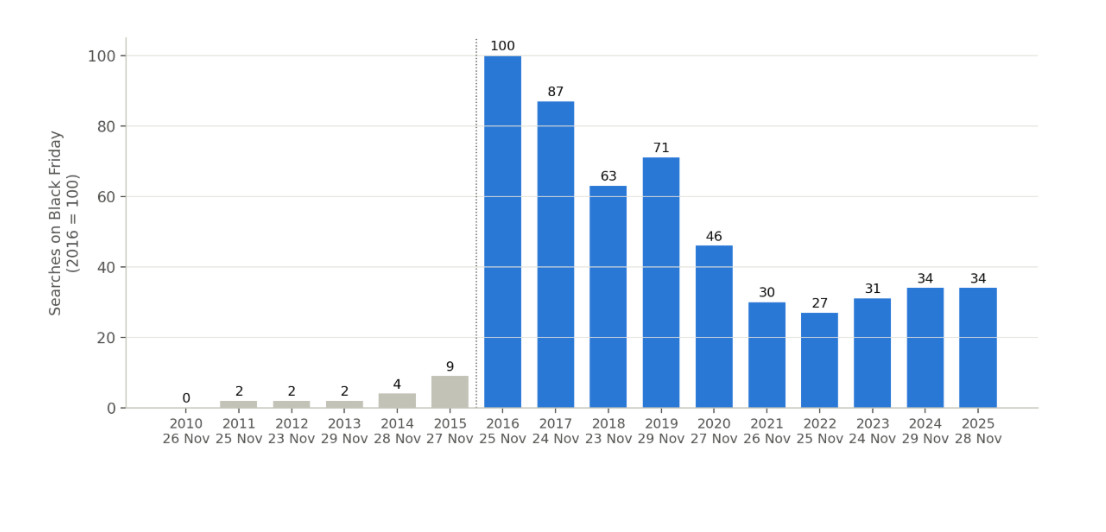
Figure 1. Google searches for "Black Friday" in Greece on Black Friday itself, 2010 to 2025 (2016 = 100). Gray bars are the years before 2016. Source: Google Trends.
People also search on the day itself. In every year from 2016 to 2025, the day with the most "Black Friday" searches in Greece was Black Friday.
What Happens to Searches for the Shops?
Searching for "Black Friday" is one thing. Do Greeks also go looking for the shops? We followed Google searches for 20 shops and e-shops that Greeks buy from:
- Electronics: Public, Kotsovolos, Plaisio, e-shop.gr, Media Markt, Germanos, Electronet and Apple
- Marketplaces and price comparison: Skroutz, BestPrice, Temu, Shein and AliExpress
- Fashion, beauty, home and sport: Zara, H&M, Hondos Center, Sephora, IKEA, Jumbo and Intersport
For each shop, we compared its searches on Black Friday with a normal October day for the same shop. A value of 1 means "just another day". A value of 3 means three times the usual searches. Then we took the average over all the shops.
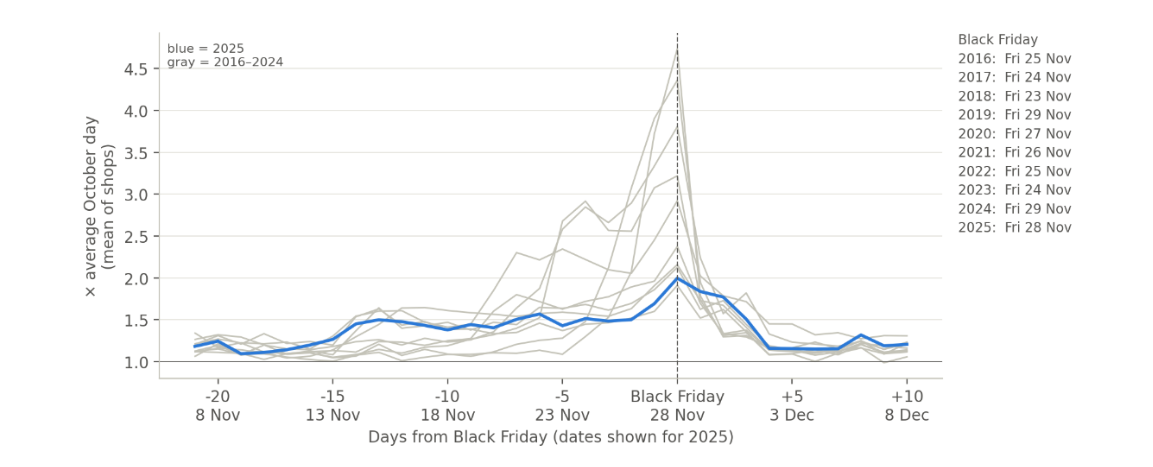
Figure 2. The Black Friday jump in shop searches started in 2016 and has been shrinking since. Each bar shows how many times more searches the average shop got on Black Friday than on a normal October day (the dashed line is a normal day). Source: Google Trends, 20 Greek shops and e-shops.
Before 2016, the Friday after Thanksgiving was an ordinary day for Greek shops: the average shop got 0.9 to 1.2 times its usual October searches. In 2016, that jumped to 4.7 times. Since then, the jump has become smaller almost every year, and since 2022 it has stayed at about 2 times a normal day.
Our guess is that the offers no longer fit into one day. With "Black Week" and month-long November sales, interest is spread over more days. Black Friday is still the busiest day, just less extreme.
One thing to keep in mind when reading the chart: each bar compares Black Friday with a normal October day for the same shop. So a shorter bar means the Black Friday jump got smaller, not that Greeks search less for these shops overall. Also, fewer shops had enough searches to measure in the early years (8 in 2010, 13 to 16 in 2011 to 2015). Public, Plaisio, Skroutz, e-shop.gr and Zara are there in every year, so the before-and-after comparison still holds.
Not all shops react the same way. Electronics and beauty shops get the biggest jumps, about 3 times a normal day in 2021 to 2025 (Kotsovolos, Plaisio, Public, Germanos, Sephora and Hondos Center). For Public, Black Friday was the busiest search day of October to December in all ten years from 2016 to 2025. Skroutz rises less, but it peaked on Black Friday in 9 of those 10 years, which fits people comparing offers before they buy. IKEA, Jumbo, Temu, Shein and AliExpress barely move.
But Did Greeks Actually Buy More?
Searches show interest, not purchases. For purchases, we used Eurostat's monthly retail trade data, which for Greece comes from ELSTAT. We looked at the volume of sales, so that higher prices don't count as "more shopping". We also used data that is not seasonally adjusted, because seasonal adjustment would remove exactly the November effect we are looking for.
Then we asked a simple question: how much higher are November sales than October, year by year?
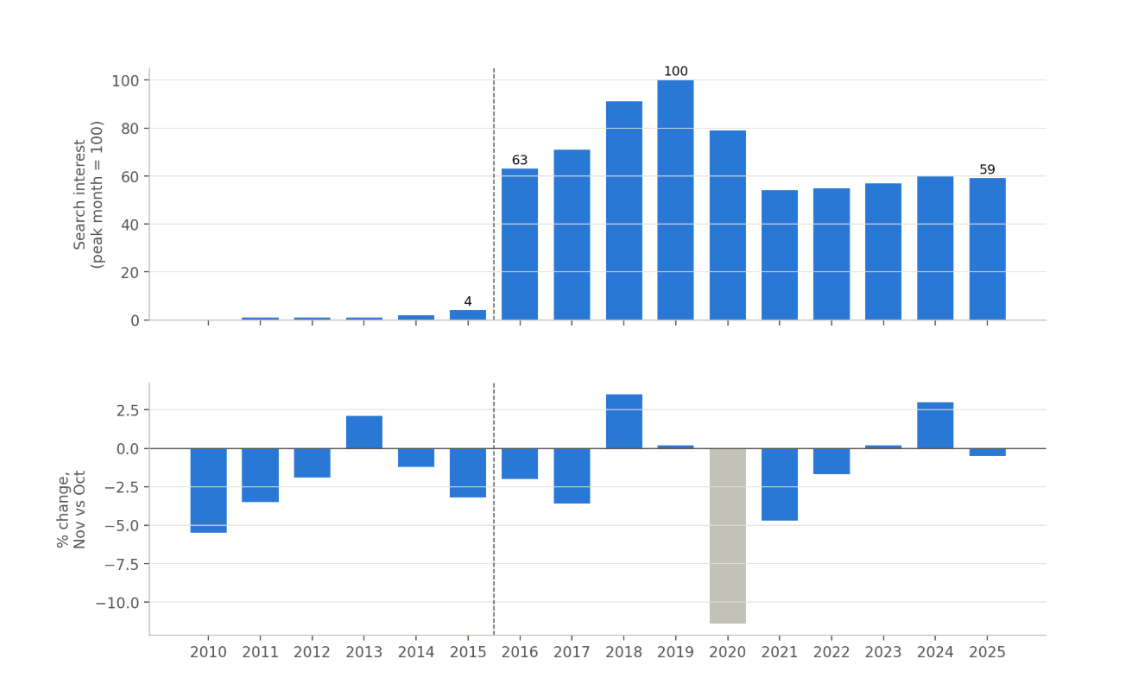
Figure 3. Top: Google searches for "Black Friday" in Greece each November. Bottom: Greek retail sales volume in November compared with October. The dashed line marks 2016, and the gray bar is 2020, when shops closed for the lockdown. Sources: Google Trends; Eurostat (sts_trtu_m).
The short answer: not by much. Before 2016, Greek November sales were on average 2.2% below October. Since 2016, they have been 0.6% below October (we left out 2020, when shops closed for the lockdown on 7 November). That's a small improvement, and it is within the normal ups and downs from one year to the next.
Some years November was higher (+3.5% in 2018, +3.0% in 2024), other years it was lower. A statistical test can't tell the difference apart from chance.
So searches went from almost zero to very high, while November sales hardly changed. A likely reason is that Black Friday moves purchases instead of adding new ones: people wait for the offers instead of buying earlier in November, or buy Christmas presents a few weeks early. Monthly data can't show this directly, so take it as a likely explanation, not a proven one.
One more detail: in Greece, November is just an average month for retail. Our biggest shopping months are December and, thanks to tourism, July and August.
How Greece Compares with the Rest of the EU
Is this a Greek thing? We ran the same November-versus-October comparison for every EU country.
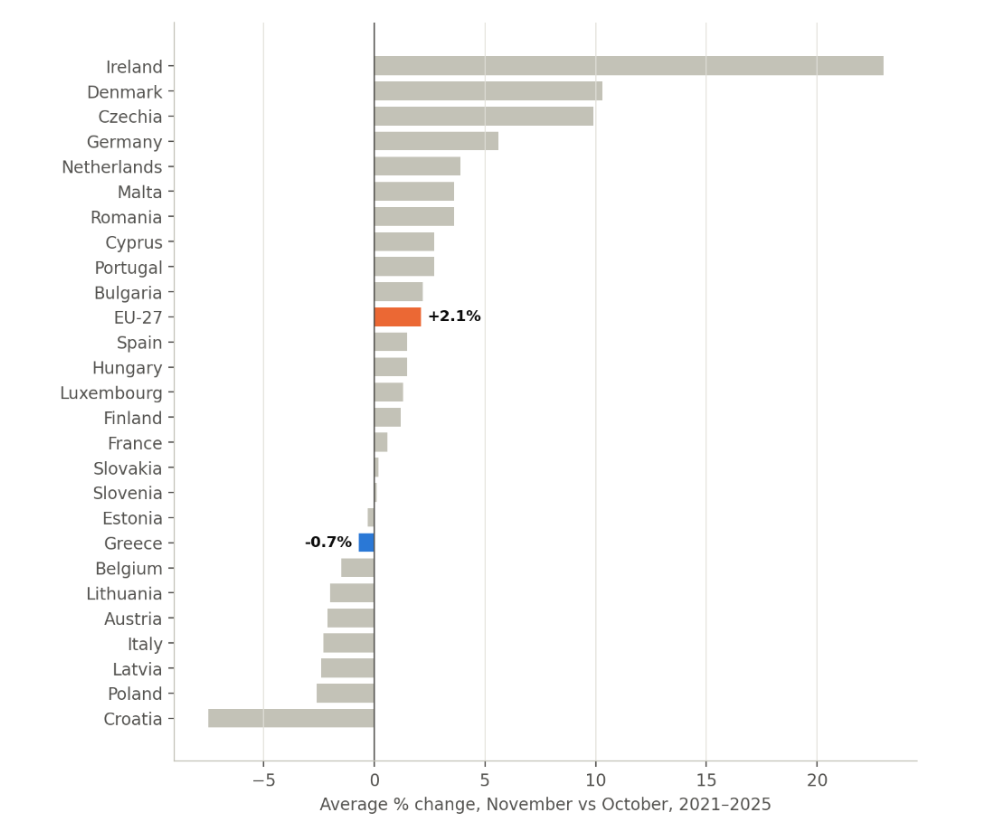
Figure 4. Average change in retail sales volume from October to November, 2021 to 2025, by EU country. Greece is in blue and the EU average in orange. Source: Eurostat (sts_trtu_m).
Across the EU as a whole, November also used to be weaker than October (2.7% lower on average in 2010 to 2015). Since 2016, it has turned positive, and in 2021 to 2025 EU November sales were on average 2.1% above October. Greece didn't follow: 0.7% below October in the same years, which puts it 19th out of 26 countries.
The biggest November jumps are in Denmark (+10%), Czechia (+10%) and Germany (+6%). Ireland tops the list at +23%, but its data only starts in 2021 and is still provisional, so we would treat it with caution. At the other end, Croatia, Poland, Latvia, Italy and Austria all have November below October.
Croatia and Greece share part of the story: a long tourist season keeps October sales high, so November looks weaker in comparison.
So What Does It All Mean?
Black Friday is now a fixed date for Greek shoppers, at least on Google. We search for it, we look up the shops and we wait for the offers. But the total amount we buy in November has hardly changed since Black Friday arrived, and Greece gets much less of a November boost than most of the EU. On top of that, the Black Friday spike in searches gets smaller every year as offers spread over the whole month.
So before you hit "buy" this Friday, maybe the better question isn't "how much will I save?" but "was I going to buy this anyway?"
About the Data
Retail sales: Eurostat, dataset sts_trtu_m (retail trade, volume of sales, calendar adjusted, 2021 = 100), data as of 25 November 2026. Searches: Google Trends for Greece, which measures relative search interest (0 to 100), not sales or the number of searches. The code, data and charts are on our GitHub link.


