


Claude vs ChatGPT for Data Science
What is ChatGPT and How Does It Function in Data Science Workflows?
ChatGPT is a large language model developed by OpenAI, built on the Generative Pre-trained Transformer architecture. It processes text using tokenization, predicting the most probable next token based on patterns learned from extensive training datasets. In data science, it serves as an interactive assistant that generates code, explains mathematical algorithms, and debugs structural errors in scripts.
The system utilizes specialized features such as Advanced Data Analysis, which provides a sandboxed Python execution environment. This allows the model to execute Python code in real-time, manipulate uploaded datasets, generate data visualizations, and perform programmatic calculations directly within the chat interface.
What is Claude and How Does It Apply to Data Analytics and AI?
Claude is a family of large language models developed by Anthropic, engineered with a focus on constitutional AI and structured reasoning. It uses a transformer-based neural network architecture optimized for high-fidelity text processing, logical reasoning, and long-context comprehension.
For data scientists and AI engineers, Claude is utilized to interpret complex technical documentation, refactor large codebases, and generate structured data outputs such as JSON or XML. Its underlying training prioritizes precision and adherence to user-defined constraints, making it a reliable tool for generating production-ready code and comprehensive mathematical proofs.
Strengths of ChatGPT and Claude in Coding and Data Science
ChatGPT Strengths
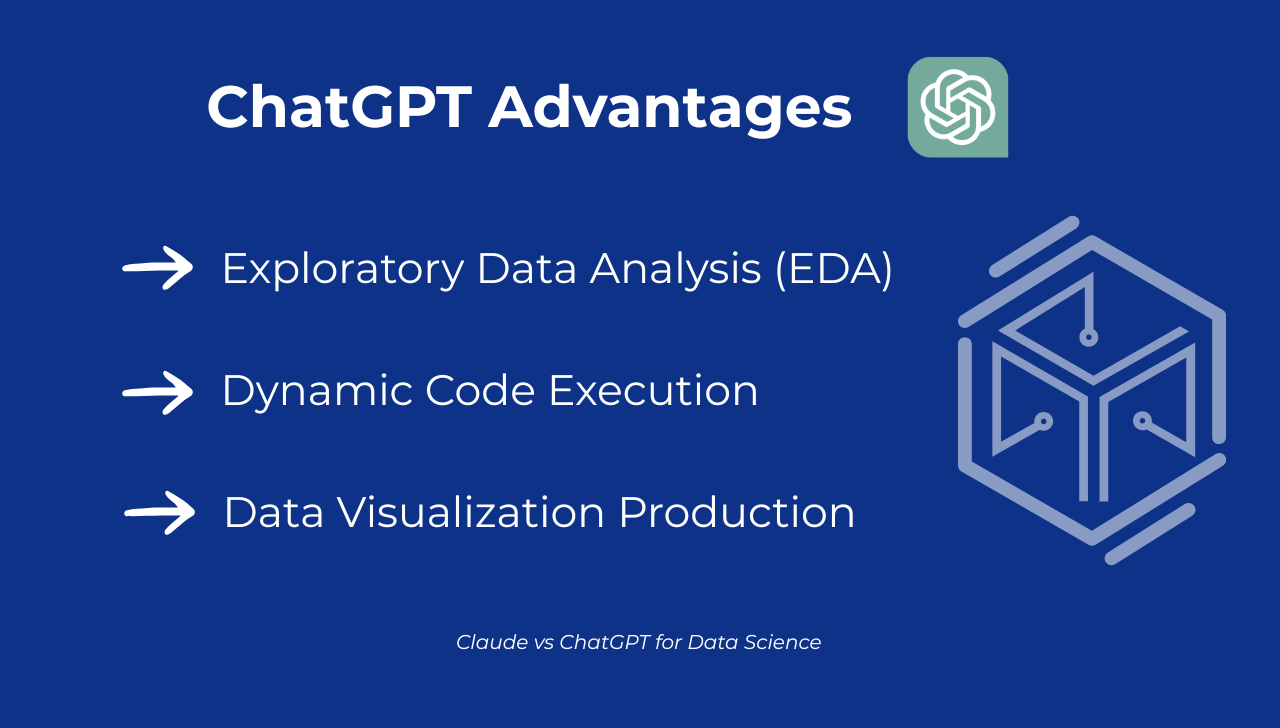
- 1. Dynamic Code Execution: The integrated Python environment allows users to verify code output instantly, minimizing runtime errors before deploying scripts to local machines.
- 2. Plugin and Custom GPT Ecosystem: Users can connect ChatGPT to external tools, databases, and APIs, expanding its functional capabilities beyond text generation.
- 3. Data Visualization Production: It creates, renders, and allows modifications to charts and graphs directly within the user interface using libraries like Matplotlib and Seaborn.
Claude Strengths
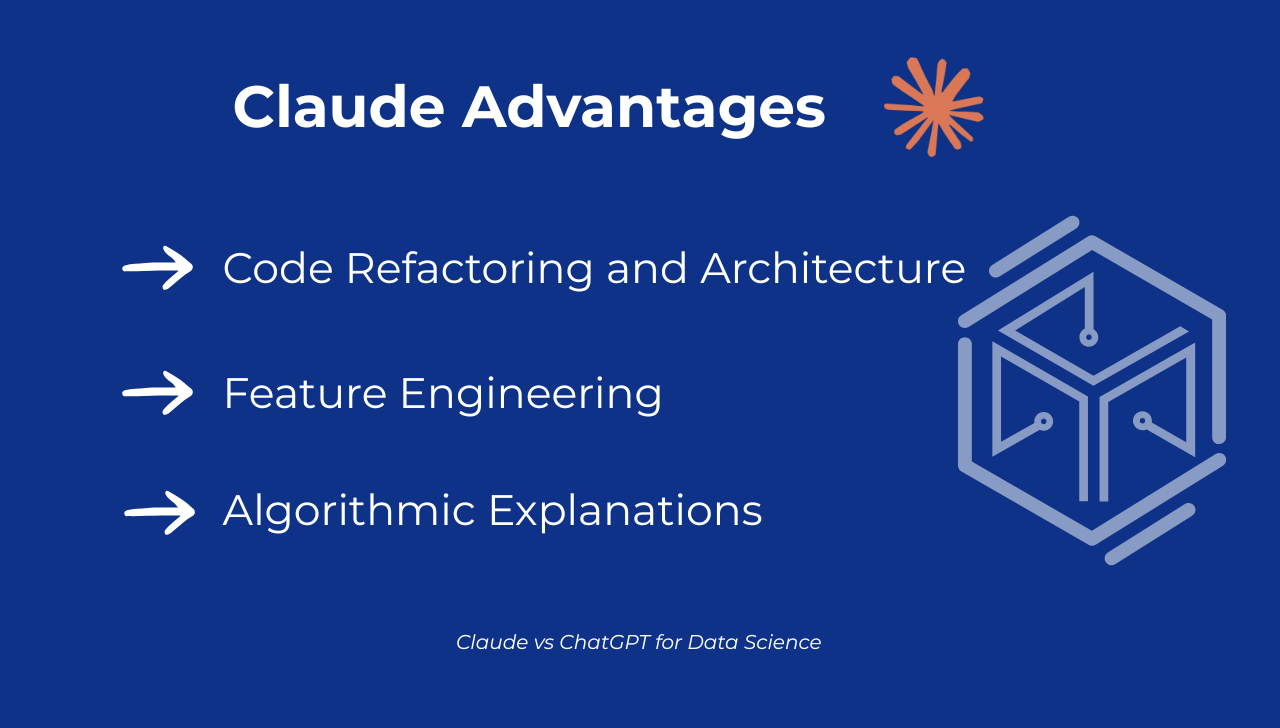
- 1. Code Refactoring and Architecture: Claude demonstrates high accuracy in understanding dependencies across multiple scripts, making it highly effective for organizing large-scale data science projects.
- 2. Structured Data Generation: The model strictly adheres to system prompts demanding specific formatting, which simplifies the process of data parsing and pipeline integration.
- 3. Algorithmic Explanations: It breaks down complex mathematical formulas and machine learning architectures into literal, precise step-by-step descriptions without omitting technical nuances.
How Do ChatGPT and Claude Compare as AI Agents and in IDE Integrations like Cursor?
The application of large language models as autonomous software agents represents a significant development in modern software engineering. Both models are integrated into Integrated Development Environments (IDEs) via APIs, with the Cursor editor serving as a primary benchmark for AI-assisted programming.
Claude demonstrates a high capacity for codebase-wide reasoning within Cursor. When acting as an agent, it scans multiple directories, maps data pipelines, and implements edits across distinct files simultaneously while maintaining syntactical consistency. Its code completions show fewer logic gaps when handling complex asynchronous operations and data processing scripts.
ChatGPT handles rapid, localized code generation and inline completions efficiently. It provides fast responses for specific function blocks, unit test generation, and syntax corrections. However, when tasked with complex agentic behaviors across wide codebases, it displays a higher frequency of context drift compared to Claude, requiring more frequent human intervention to correct architectural alignment.
Context Window Limitations and Pricing
Context window capacity determines the volume of data a model can retain in its active memory during a single conversational session. This metric directly impacts how much source code or dataset documentation a user can upload simultaneously.
- Claude Context Window: Models like Claude 3.5 Sonnet offer a context window of 200,000 tokens, which equates to roughly 150,000 words or several hundred pages of technical documentation and code files.
- ChatGPT Context Window: GPT-4o operates with a context window of 128,000 tokens, which accommodates approximately 96,000 words before older inputs begin to rotate out of active memory.
Pricing
- ChatGPT Plus: The base price is €23.50 per month.
- Claude Pro: The base price is ~€17 per month.
Comparing ChatGPT and Claude on their Free Tier
The free tiers of both platforms provide access to their respective models, but they enforce strict usage limitations that alter how data scientists interact with the software.
- ChatGPT Free Tier Restrictions: OpenAI restricts free users to approximately 10 messages every 5 hours. The system uses a fast model variant for these queries. Once the user exceeds the 10-message limit, the system automatically redirects all further queries to a smaller, less capable mini model until the time limit resets. Additionally, the free version restricts the context window to approximately 16,000 tokens. This low token limit prevents users from uploading large datasets or lengthy code files.
- Claude Free Tier Restrictions: Anthropic provides free users with access to its primary Sonnet model. The system calculates a dynamic limit based on server demand and the length of the conversation. Users typically receive an allocation of 15 to 40 messages per 5-hour window. If a user uploads large files or types very long prompts, the system depletes this message limit faster. Free users have the ability to upload up to 20 files per chat, with a strict maximum size of 30 Megabytes per file. This specific feature allows users to analyze multiple CSV files simultaneously without paying for a subscription.
Advanced Statistical Modeling and Machine Learning with ChatGPT and Claude
A critical requirement for data scientists is the formulation of machine learning models and statistical validation. ChatGPT excels at generating standard boilerplate code for model training using libraries such as Scikit-Learn, XGBoost, and PyTorch. Its iterative Python environment enables users to run hyperparameter tuning scripts step-by-step, review the accuracy metrics, and instantly adjust the optimization parameters.
Claude approaches statistical modeling through structural analysis. It is highly proficient at designing custom neural network architectures, writing complex mathematical optimization routines, and debugging low-level Tensor shape mismatches in deep learning frameworks.
Claude provides highly literal breakdowns of statistical anomalies, such as data leakage or class imbalance, and provides specific architectural solutions to mitigate these problems within the code infrastructure.
Which LLM Demonstrates Better Performance in EDA and Feature Engineering?
Exploratory Data Analysis (EDA) requires a balance of statistical calculations and structural modifications.
ChatGPT is highly effective for rapid EDA due to its ability to ingest raw CSV or Parquet files, run descriptive statistical functions automatically, and pinpoint missing values or outliers. The user receives immediate visual feedback, making it an efficient tool for the initial stages of data ingestion.
For automated feature engineering, Claude provides distinct structural advantages. Creating new features from raw datasets requires deep domain knowledge and logic, such as extracting temporal patterns, encoding categorical hierarchies, or mathematical transformations.
Claude evaluates the schema of a database and systematically writes feature engineering functions that prevent data leakage and maintain computational efficiency, ensuring the resulting scripts are ready for deployment into production data pipelines.
Conclusion: Choosing the Right LLM for Your Data Science Stack
The choice between ChatGPT and Claude depends entirely on the specific requirements of your data science workflow. Neither tool completely eclipses the other, instead, they serve different operational purposes.
- Choose ChatGPT if your daily tasks rely heavily on rapid data prototyping, immediate data visualization, sandboxed code execution, and quick syntax debugging.
- Choose Claude if your work involves managing large multi-file codebases, building intricate machine learning architectures, refactoring complex code pipelines, and processing massive text documents within a large context window.
Integrating both models into your technical workflow provides the highest utility, using ChatGPT for fast data experimentation and Claude for rigorous code engineering and architecture design.
.jpg)


