


Claude vs. Gemini: How Do They Compare
The Google Multimodal Ecosystem
Google Gemini represents the current pinnacle of multimodal LLMs. The base model architecture processes various types of data simultaneously. This natively includes text, code, images, audio, and video. Google engineered the system using a Transformer based structure optimized for high performance reasoning across complex tasks. By utilizing vast infrastructure, the model delivers low latency responses and high throughput. It integrates deeply into the Google Cloud ecosystem through Vertex AI and the Gemini API. The core design philosophy balances creative generation with technical precision. Advanced versions, specifically Google Gemini 3.1 Pro, function as sophisticated reasoning engines for software development and data science.
Anthropic Claude and Constitutional AI
Anthropic built its primary models around a framework called Constitutional AI. This method trains the AI to follow specific rules and principles to ensure safety, reliability, and neutrality. Anthropic focuses on maintaining a model that behaves predictably under professional constraints. This approach prioritizes the reduction of hallucinations and the delivery of technically accurate outputs for data engineering tasks. Claude 3.5 Sonnet is recognized across the industry for exceptional logical reasoning and advanced coding capabilities. Technical professionals distinguish Claude by its ability to write clean and idiomatic code. It seamlessly follows complex multi step instructions with minimal drift.
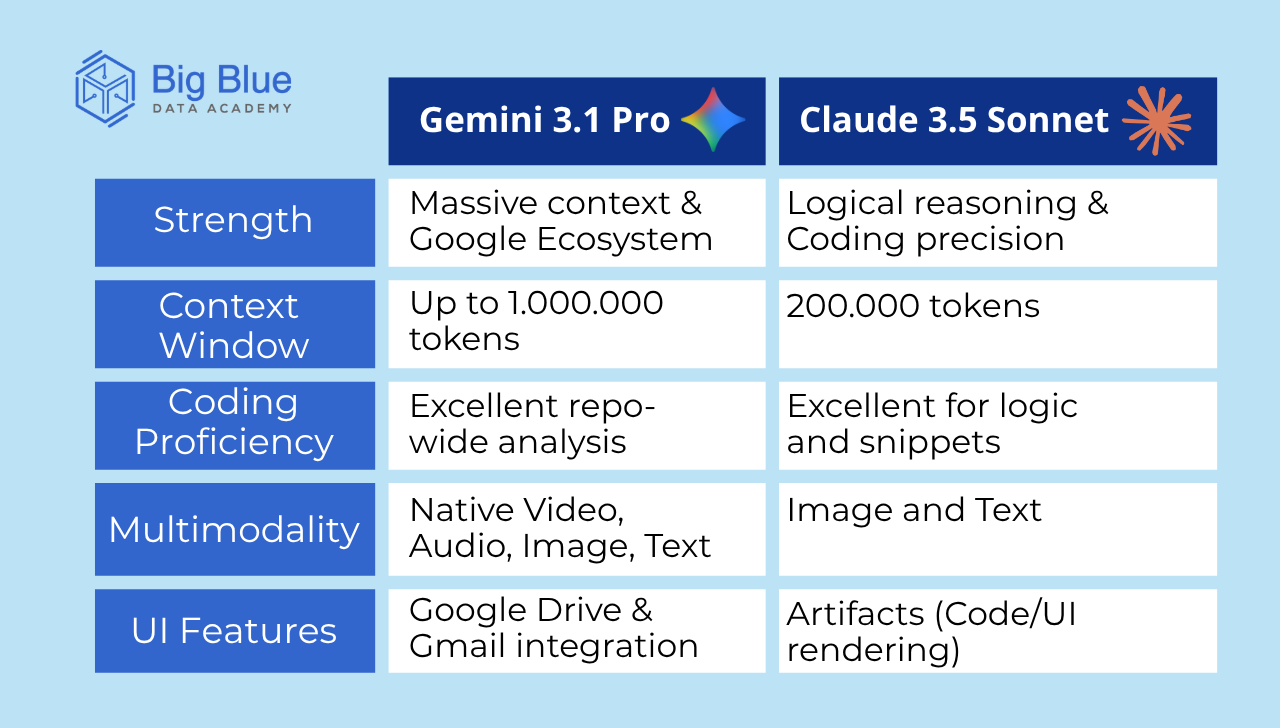
Comparison: Gemini vs. Claude
IDE Integration and Google Antigravity
The integration of these models into Integrated Development Environments (IDEs) has transformed the software development lifecycle.
Google’s Antigravity initiative represents a sophisticated advancement in this area, specifically optimized for the Gemini 3.1 Pro model. Antigravity is designed to be more than a simple autocomplete tool; it functions as a deep-context agent within the IDE that understands the entire repository. This allows developers to perform natural language searches across their code, automate the generation of unit tests based on existing patterns, and receive real-time suggestions that are contextually aware of the project’s specific architecture.
While Claude is frequently used via extensions like Cursor or the official Anthropic API in VS Code, Gemini’s integration is native to Google’s suite of developer tools, including Project IDX. The advantage of using Gemini within an environment like Antigravity is the seamless connection to Google Cloud services. A developer can write a function and immediately ask the agent to generate the necessary Terraform scripts for deployment or the Kubernetes configuration files, all while the model retains the context of the active code. This reduces the cognitive load on the engineer, as the model handles the boilerplate and configuration tasks that typically interrupt the creative coding process.
Free Tier Comparison
The cost of these tools is a primary consideration for IT professionals and organizations in Greece.
Google Access: Free users can experience limited access to the flagship Gemini 3.1 Pro model through the application Thinking feature, heavily capped by server demand. The Google AI Studio provides a generous free tier for prototyping restricted to the Gemini 2.5 series. The free tier includes standard ecosystem benefits such as 15GB of Drive storage.
Anthropic Access: Claude provides a permanent free tier via its web interface for the Sonnet model. This tier includes the Artifacts feature, web search, and document uploads. The primary constraint is a strict rolling message limit. The advanced Claude Code CLI tool is excluded from the free tier. However, new developers signing up for the API receive approximately $5 in free credits.
For professionals evaluating these tools on a budget in Greece, the Claude free tier is highly effective for front end prototyping due to the Artifacts inclusion. The Gemini free tier is better suited for users who want to build high volume API prototypes using the older Gemini 2.5 Flash models. Both companies provide API access on a consumption basis, which is often the most cost effective route for developers.
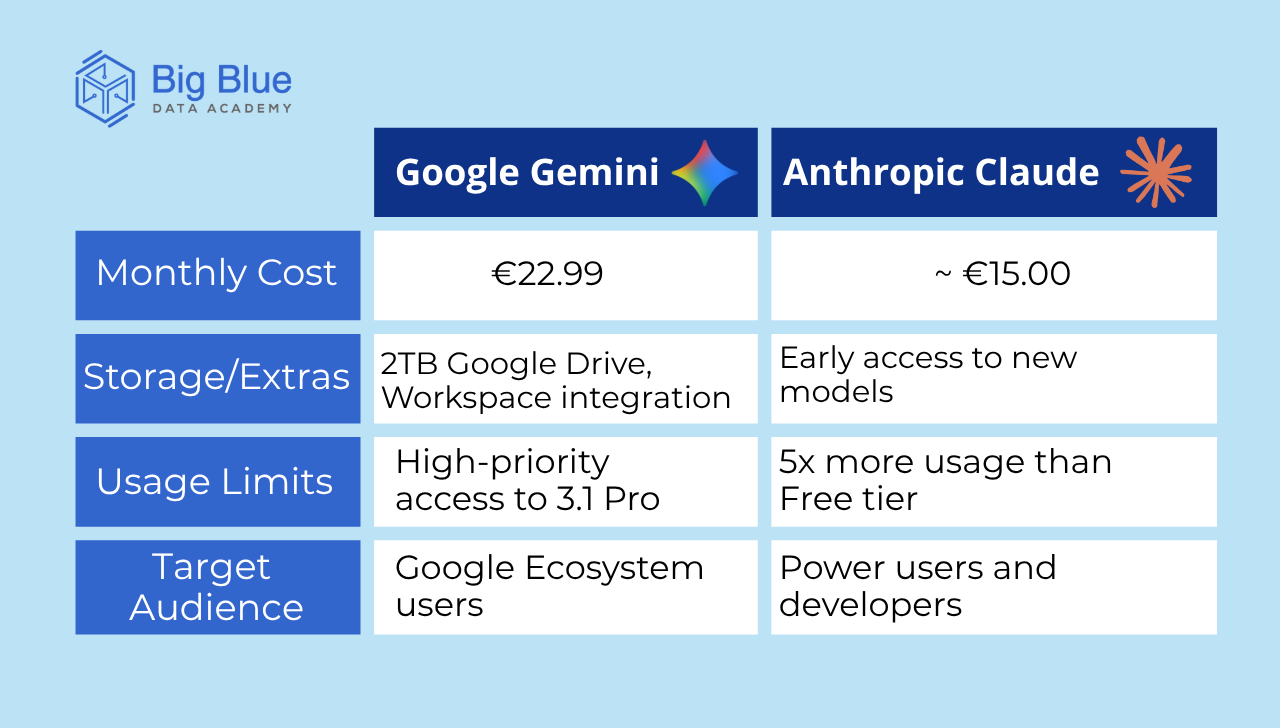
Pricing and Benefits in Greece
For professionals and organizations in Greece, the cost of these tools is a primary consideration for long-term adoption.
Google Gemini 3.1 Pro is available through the Google One AI Premium plan and Google Workspace extensions.
Anthropic Claude offers a Pro subscription for individual users.
Both companies provide API access on a consumption basis, which is often the most cost-effective route for developers building custom integrations or using these models within specialized IDEs.
Pros & Cons
Google Gemini 3.1 Pro
- Pros:
- 1. Unmatched context window for large-scale repo analysis.
- 2. Deep integration with Google Cloud and Workspace tools.
- 3. Native multimodal processing (video and audio).
- Cons:
- 1. Can occasionally be "chatty" or overly verbose.
- 2. Reasoning on extremely niche coding logic sometimes lags behind Claude.
Anthropic Claude 3.5 Sonnet
- Pros:
- 1. Highest rated for coding precision and logical reasoning.
- 2. Artifacts feature significantly improves the developer experience.
- 3. Clean, professional tone with minimal filler text.
- Cons:
- 1. Smaller context window compared to Gemini 3.1 Pro.
- 2. No native video or audio file ingestion
The Shift to Agentic AI in Coding
Agentic AI represents the current standard in software development automation. Unlike standard chat interfaces that require continuous human prompting, agentic models independently plan, execute, and verify multi-step engineering tasks. Both Google and Anthropic have introduced sophisticated agents designed to operate directly within development environments.
Autonomous Engineering with Gemini Agents
Google integrates agentic capabilities within the Gemini 3.1 Pro ecosystem primarily through the Gemini CLI. This open-source AI agent connects directly to Google Cloud models and operates within the developer's terminal. It handles complex, long-horizon tasks such as system-wide code refactoring, database migration, and automated unit test generation across large repositories.
Because Gemini 3.1 Pro utilizes a one-million token context window, the agent processes entire project structures without losing track of dependencies. Developers issue a single command, and the agent sequentially writes the code, updates documentation, and modifies configuration files. The system includes an "auto-approve" mode, allowing the agent to execute and commit changes continuously. This workflow shifts the engineer's role from writing raw syntax to reviewing high-level architectural decisions.
Key agentic operations powered by Gemini include:
Automated Legacy Migration: Translating entire backend frameworks to modern microservices in a single continuous operation.
Repository-Wide Documentation: Generating accurate docstrings and inline comments across all files simultaneously.
Terminal-Based Execution: Running bash commands, deploying test servers, and validating output directly within the local environment.
Claude Code and Multi-Agent Workflows
Anthropic approaches agentic coding through Claude Code, powered by frontier models like Claude Opus 4.7 and Sonnet 4.6. Claude Code operates as a persistent agent that runs in the background of the integrated development environment. It focuses on high-precision, long-running tasks that previously required close supervision from senior engineers.
A core advantage of Claude's system is its strict verification protocol and "auto mode." When assigned a complex objective, the agent plans the architecture, writes the implementation, and runs the output through testing frameworks to verify accuracy before alerting the user. Furthermore, Anthropic supports multi-agent coordination. Organizations deploy specialized Claude agents that work in parallel to finalize a feature. This team-based workflow ensures production-ready code with minimal human intervention.
Key agentic capabilities of Claude Code include:
Autonomous Debugging: Identifying race conditions and logical errors, writing the fix, and running internal tests to confirm resolution.
Background Execution: Managing multi-day engineering tasks autonomously with minimal required user interruptions.
Specialized Roles: Orchestrating coordinated efforts where separate agents handle code generation, security auditing, and quality review simultaneously.
What to Choose: Gemini or Claude
The choice between Gemini 3.1 Pro and Claude 3.5 Sonnet depends strictly on the specific requirements of the project and the existing technical environment. If your work involves analyzing massive amounts of data, such as entire books, long video files, or codebases with thousands of files, Gemini 3.1 Pro is the superior choice. Its ability to maintain a "global view" of a project via its context window is currently unmatched. It is also the logical choice for organizations already heavily invested in the Google Cloud Platform or Google Workspace.
If the primary goal is high-precision coding, complex logical derivation, or front-end prototyping, Claude 3.5 Sonnet is the more effective tool. Its reasoning capabilities and the Artifacts UI make it a highly productive partner for software engineers who need accurate, idiomatically correct code on the first attempt. Claude is often preferred for standalone development tasks where the user needs a sharp, focused assistant that prioritizes technical accuracy over ecosystem features. Most professionals find value in using both: Gemini for "big picture" data ingestion and Claude for "deep dive" logical execution.
.jpg)


