


.png)
Data Analytics vs Business Intelligence: The 2026 Tech Guide
Defining Business Intelligence in Corporate Contexts
Business Intelligence (BI) refers to the procedural and technical infrastructure that collects, stores, and analyzes the data produced by a company. It focuses on descriptive analytics, which means it provides an accurate report of historical and current data to help businesses understand what happened in the past and what is happening right now. BI systems utilize predefined metrics and key performance indicators to track business operations, presenting this information through structured dashboards, automated reports, and standard data visualizations.
Defining Data Analytics and Its Predictive Capabilities
Data Analytics encompasses a broader and mathematically deeper set of processes designed to extract actionable insights from raw data, extending beyond the strictly descriptive nature of Business Intelligence.
While it includes descriptive analysis, Data Analytics heavily emphasizes diagnostic, predictive, and prescriptive analytics. Professionals in this field do not simply report on past events, but they apply statistical models and mathematical algorithms to determine why a specific event occurred, what is statistically likely to happen in the future, and what specific actions the organization should take to achieve a desired operational outcome.
Data Analytics involves complex data processing, utilizing unstructured or semi-structured data sets from diverse external and internal sources.
The methodologies applied include regression analysis, hypothesis testing, machine learning, and data mining.
Consequently, the focus shifts from monitoring current operations to identifying hidden statistical patterns, calculating probabilities for future consumer behaviors, and optimizing complex systems.
Key Differences in Scope, Tools, and Technical Requirements
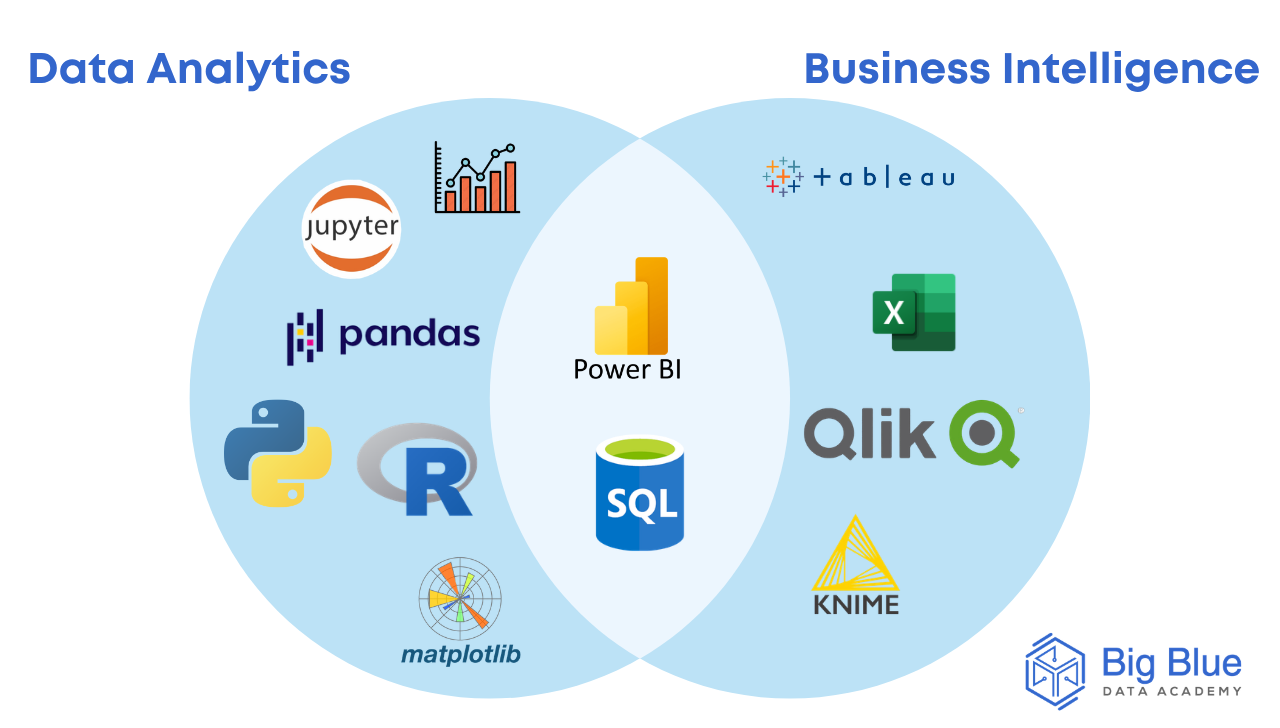
The distinction between Business Intelligence and Data Analytics becomes highly apparent when examining their respective scopes, software tools, and technical skill requirements.
Business Intelligence operates with a strict focus on structured data and utilizes specialized commercial software designed for data visualization and query generation.
More specifically ,the tools being used are the following:
Microsoft Power BI
Microsoft Excel
KNIME
Tableau
Qlik Sense.
SQL
These tools are engineered to be accessible to business users, facilitating the creation of standard reports through graphical user interfaces.
Data Analytics frequently requires interacting with large volumes of unstructured data, necessitating advanced programming languages and computational tools.
Professionals in Data Analytics write code in languages like Python or R to manipulate datasets, perform advanced statistical calculations, and build predictive algorithms.
More specifically, the tools being used are the following:
Python
Jupyter notebooks
SQL
Power BI
Understanding of basic statistics and linear algebra
Furthermore, while both disciplines require a functional understanding of SQL for data extraction, Data Analytics demands a significantly higher level of mathematical proficiency, specifically in statistics, probability theory, and linear algebra.
The scope of BI is structurally retrospective and operational, delivering predefined metrics, whereas the scope of Data Analytics is prospective and exploratory, formulating new questions and testing hypotheses through complex computational methodologies.
How to become a Business Analyst or a Data Analyst in 2026?
To start a career as a Business Intelligence Analyst or Data Analyst, structured and practical training in modern data technologies is required.
The transition to these professional roles is achieved exclusively through the acquisition of specific technical skills, which include programming, statistical analysis and the use of specialized software.
BigBlue Data Academy offers intensive training programs, known as bootcamps, which fully cover these technical requirements. Through these bootcamps, participants are taught programming languages such as Python and SQL, as well as data visualization tools. By applying theoretical technical knowledge to real datasets, this targeted educational process immediately prepares learners for their successful entry into the job market.
Which path to choose in 2026?
As we navigate the data landscape of 2026, the debate between Data Analytics and Business Intelligence (BI) has evolved from a question of binary choice into a nuanced discussion of strategic integration.
Historically, BI focused on descriptive analytics, providing retrospective dashboards that answered "what happened" to ensure operational efficiency. Conversely, Data Analytics pushed into the predictive and prescriptive realms, utilizing advanced machine learning models to determine "what will happen" and "what actions to take."
Today, artificial intelligence has blurred these boundaries, embedding predictive capabilities directly into standard BI tools and making sophisticated data science highly accessible to business users. However, distinguishing between the two remains critical for organizational resource allocation. BI is the foundational system of a company, it offers immediate visibility and democratizing data across departments to drive daily operational decision making processes.
Data Analytics, meanwhile, functions as the strategic brain, tackling complex, unstructured data to uncover hidden market opportunities, optimize complex algorithms, and drive long term innovation.
Ultimately, modern enterprises should not view this as a competition but rather as a symbiotic continuum. True competitive advantage in 2026 demands a robust BI infrastructure to maintain present stability, seamlessly paired with advanced Data Analytics to architect future growth.
Q&A session
Q:Do I need advanced coding and math skills for both roles?
A: Not for both. BI relies on software like Power BI, Tableau, and SQL. Data Analytics, however, requires advanced programming in Python or R, plus a significantly higher proficiency in statistics and linear algebra.
Q:How can I start a career as a Business or Data Analyst in 2026?
A: You need structured, practical training in technical skills like programming and specialized software. BigBlue Data Academy offers intensive bootcamps teaching Python, SQL, and data visualization using real datasets to quickly prepare you for the job market.
.jpg)


