


Retrieval-Augmented Generation: A Beginner's Guide
What is Retrieval-Augmented Generation?
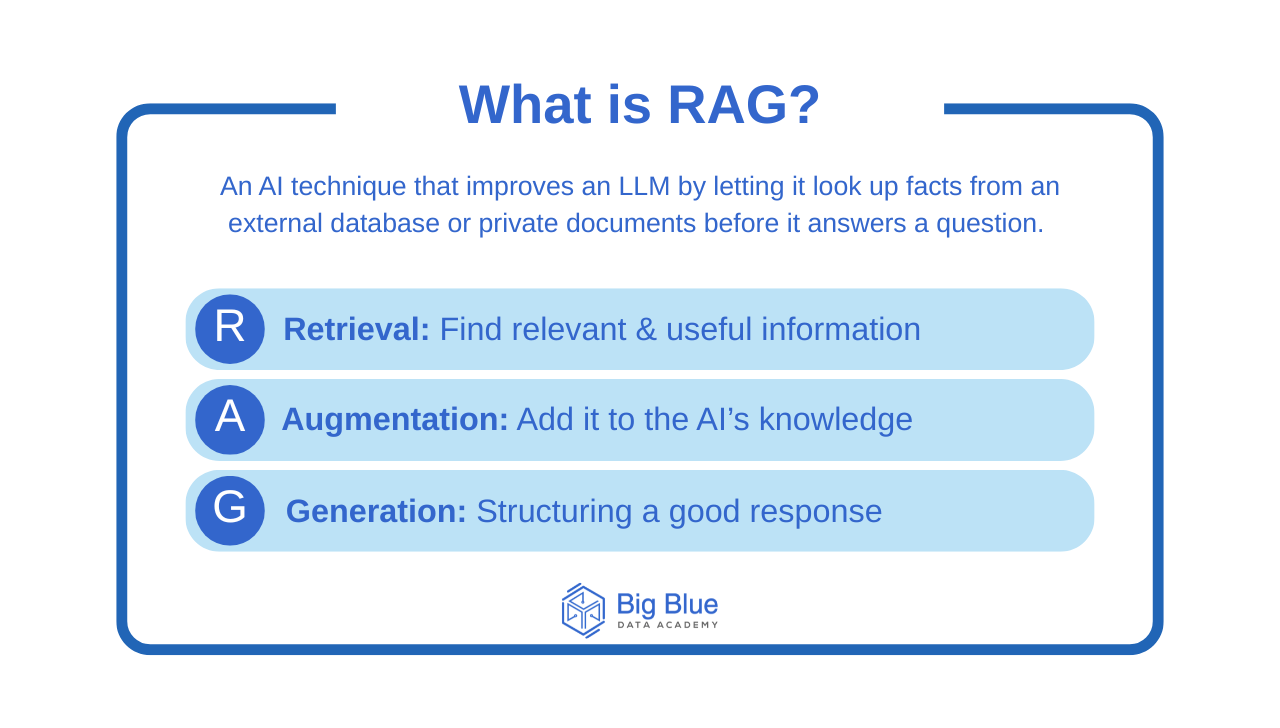
Retrieval-Augmented Generation, commonly referred to as RAG, is an artificial intelligence technique that improves a large language model by letting it look up facts from an external database or private documents before it answers a question. Standard large language models generate responses based exclusively on their parametric memory, the static information embedded within their neural network weights during their original training phase. Consequently, when users ask questions about recent events, proprietary organizational data, or highly specialized domain knowledge that was not part of the initial training dataset, standard models often produce incorrect assertions or fail to answer entirely.
RAG resolves this foundational limitation by introducing an information retrieval step before the text generation process occurs. When a user submits a query to a RAG-enabled system, the architecture first searches an external, designated knowledge base to extract relevant documents, data snippets, or factual records. The system then combines the retrieved information with the user's original query to construct an enriched prompt. This comprehensive prompt is subsequently processed by the large language model to generate a final response that is strictly grounded in the retrieved facts. By dynamically supplying relevant context at inference time, RAG separates the reasoning capabilities of the language model from its data storage limitations. This architectural separation allows organizations to deploy artificial intelligence applications that continuously reference accurate, up-to-date, and verifiable information without incurring the substantial computational and financial costs associated with retraining the foundational model.
How Retrieval-Augmented Generation Works
The operational workflow of a Retrieval-Augmented Generation system executes across three distinct sequential phases: indexing, retrieval, and generation. Understanding these mechanics requires examining how textual data moves through the underlying system architecture from raw files to the final output.
The process begins with the indexing phase, where external documents (such as PDF files, database records, or technical manuals) are ingested and processed. Because LLMs cannot process massive unstructured files simultaneously due to input context window constraints, the system divides these documents into smaller, manageable text segments known as chunks. An embedding model then converts each chunk into a high-dimensional numerical representation called a vector embedding. These vectors are stored within a specialized vector database that indexes them based on mathematical similarity.
During the retrieval phase, a user submits a natural language query to the system. The same embedding model translates this query into a numerical vector. The retrieval mechanism calculates the mathematical distance between the query vector and the stored document vectors within the database, extracting the top-ranked text chunks that share the highest semantic relevance to the user's request.
Finally, in the augmentation and generation phase, the system concatenates the extracted text chunks with the user's initial query into a single, unified prompt. The large language model analyzes this context-rich prompt and generates a definitive response that directly synthesizes the facts contained within the retrieved segments.
Core Components of a RAG System
A robust Retrieval-Augmented Generation architecture relies on the seamless integration of five primary engineering components, each performing a specific computational task within the data pipeline:
Data Ingestion and Chunking Pipeline
This component extracts text from heterogeneous data sources and applies text-splitting algorithms. Proper chunking is critical because text segments must remain large enough to retain meaningful semantic context, yet concise enough to fit within the computational limits of the embedding model and the language model's context window.
Embedding Model
A specialized neural network designed to transform textual data into numerical vector arrays. By converting words and sentences into points in a multi-dimensional coordinate space, the embedding model enables the system to measure semantic relatedness between different pieces of text through mathematical operations such as cosine similarity.
Vector Database
A storage infrastructure specifically optimized for storing, indexing, and executing rapid similarity searches over high-dimensional vector data. Unlike traditional relational databases that match exact keyword strings, vector databases retrieve records based on conceptual proximity and mathematical distance.
The Retriever
The algorithmic controller that receives the vectorized user query, queries the vector database, applies filtering algorithms, and ranks the retrieved text chunks to select the most relevant data subsets for prompt augmentation.
The Generator (Large Language Model)
The generative text engine that receives the augmented prompt containing both the user's instructions and the retrieved factual context. It synthesizes the provided data to formulate a coherent, grammatically structured, and factually grounded response.
Key Advantages of Implementing RAG
Implementing Retrieval-Augmented Generation provides significant technical and operational advantages for enterprises seeking to deploy reliable artificial intelligence solutions:
Mitigation of Factual Inaccuracies
Standard large language models often generate plausible-sounding but factually incorrect statements, a phenomenon known as hallucination. By constraining the model's generation process to explicitly retrieved reference documents, RAG drastically reduces error rates and ensures output accuracy.
Real-Time Data Accessibility
Static language models become outdated immediately after their training cut-off date. RAG architectures allow systems to access real-time information by simply updating the documents stored within the underlying vector database, ensuring that generated answers reflect the most current operational data without model retraining.
Cost-Effective Domain Adaptation
Training a custom foundational language model from scratch or performing continuous fine-tuning requires significant computational resources, specialized hardware, and extensive engineering labor. RAG achieves domain specificity by leveraging pre-trained models alongside proprietary data archives, reducing deployment costs and accelerating development timelines.
Source Attribution and Verifiability
Because the generation model utilizes discrete retrieved text chunks, engineering teams can configure the system to cite the exact source documents, page numbers, or database records used to construct the answer. This capability allows users to audit and verify the output against primary sources.
Granular Access Control and Data Security
In enterprise environments, sensitive information must remain restricted to authorized personnel. RAG systems can integrate user authentication protocols directly into the retrieval phase, ensuring that the model only retrieves and generates answers from documents the specific user has permission to view.
Primary Enterprise Use Cases
Retrieval-Augmented Generation has become the foundational architecture for numerous enterprise applications where data accuracy, domain specificity, and security are mandatory operational requirements:
Enterprise Knowledge Management and Internal Search
Large organizations generate vast quantities of internal documentation, including technical wikis, human resource policies, project proposals, and engineering specifications. RAG systems replace legacy keyword search engines by allowing employees to query internal databases using natural language and receive synthesized, accurate answers with direct references to relevant internal documents.
Automated Customer Support and Service Desk Systems
Customer service departments deploy RAG-enabled conversational agents integrated directly with product manuals, troubleshooting guides, and ticketing histories. These systems provide instant, accurate resolutions to complex technical queries without human intervention, significantly reducing response times and operational overhead.
Legal and Regulatory Compliance Analysis
Legal professionals and compliance officers utilize RAG architectures to navigate extensive corpora of case law, statutory regulations, and corporate contracts. The system can extract specific clauses, summarize compliance requirements, and compare contract terms against current legal standards while minimizing the risk of generating fictitious legal precedents.
Medical and Healthcare Clinical Documentation
Healthcare institutions apply RAG to query medical literature, clinical trial protocols, and anonymized patient records. By grounding responses in verified medical research, practitioners can rapidly access relevant diagnostic criteria and treatment guidelines during clinical decision-making.
Software Engineering and Technical Documentation Assistance
Engineering teams connect RAG systems to source code repositories, API documentation, and system architecture logs to assist developers in debugging code and understanding complex technical infrastructures.
Key Challenges and Best Practices for Implementation
While Retrieval-Augmented Generation offers substantial benefits, deploying a production-grade system requires navigating several complex engineering challenges and adhering to established architectural best practices:
Optimizing Chunking Strategies
The method used to partition source documents directly impacts retrieval quality. If text chunks are too small, they lack the necessary context for the language model to understand the information.If they are too large, they introduce irrelevant data that dilutes the prompt and consumes valuable context window space. Engineers must implement semantic chunking strategies tailored to the specific document structure.
Advanced Retrieval and Reranking
Simple vector similarity search often retrieves documents that share keywords or surface-level semantic proximity without answering the user's specific question. To improve precision, professional implementations utilize hybrid search techniques (combining dense vector search with sparse keyword search) and introduce a secondary reranking model to re-order retrieved chunks based on strict relevance before sending them to the generator.
Evaluating RAG Performance
Assessing a RAG pipeline requires specialized evaluation frameworks that independently measure both the retrieval and generation phases. Engineering teams rely on metrics such as context relevance, answer faithfulness, and answer relevance to quantitatively monitor system performance and prevent regressions during system updates.
Managing Data Quality and Hygiene
A RAG system is fundamentally limited by the quality of the data indexed within its vector database. Organizations must establish rigorous data governance protocols to remove duplicate files, archive outdated documentation, and resolve conflicting information before indexing occurs.
.jpg)


