


SQL Is Not Dead: Why Data Analysts Still Need It in the Age of AI
Every few months, a new wave of AI tools drops promising to completely change how we work with data. Natural language queries, auto-generated dashboards, one-click insights…
Honest thoughts? Much of that promise has been realized. AI has really changed the way a normal workday looks like in data.
So, now the question is: where does SQL fit into all of this?
You've probably already seen that debate a lot recently, so let's talk about something more useful instead. What's actually worth talking about is what the relationship between SQL and AI looks like on the job, and importantly: why it matters before you start building a career in data.
What AI Is Actually Good At (and where it saves you time)
Before criticizing AI, it's worth acknowledging how much it has already accomplished. Its strengths are real and increasingly visible in everyday work. Understanding those is essential if we want an honest conversation about its limitations.
AI tools have gotten really good at turning plain English into working SQL. You say what you want, and you get a query back. For clean, straightforward tasks, such as: quick summary table, filtering by date, or joining two obvious tables, it's fast and it works. If you already know what you're looking for, AI saves you a lot of time.
In addition, it's also incredibly useful for the tasks that consume time without requiring much thought: syntax you haven't touched in months, code you've written countless times before, or small details you'd likely overlook on a first pass. In those situations, AI isn't replacing expertise- it's removing friction, letting you focus on the work that actually demands your attention.
The issue isn't what AI can do. Instead, it's what it can't see.
Silent Failures: The data gaps that AI cannot see
Let’s be honest here: AI knows SQL. However, it doesn't know your data. And in practice, that's the difference between a query that runs and a query that produces the right answer.
It doesn't know your orders table has duplication issues because a migration went wrong six months ago. It doesn't know that user_id in your app database doesn't map cleanly to customer_id in your modern data warehouse. It doesn't know the date column you're filtering on is in UTC while your team reports in local time.
The query will look fine. It'll run clean. On the other hand, the number it gives you can be completely wrong.
If you can't read and validate the query yourself, you won't catch the mistake. You'll only discover it when the wrong number lands in a dashboard, a report, or a meeting where decisions are being made. By then, the damage is already done.
This isn't some rare edge case. It's a routine reality of working with data. AI can generate code, but it can't take responsibility for the outcome. That responsibility still belongs to the person who signs off on the work. And that's the line that separates professionals who own their results from those who blindly trust whatever the tool produces.
SQL isn’t just code: it’s how you train your analytical mind
This is the part that usually tends to get left out: SQL isn't just a language you type. It changes how you think about data.
When you write a query yourself, you have to be specific about everything.
Which table? What does this join actually do to the row count? What happens to the nulls here? That habit of being precise, knowing exactly what you're asking and what you expect back, is what makes someone good at working with data. SQL helps you in building that instinct.
In addition, it also makes AI more useful, not less. When you know what a correct query looks like, you can tell when something's off. A filter that shouldn't be there, a join that's doubling rows, logic that doesn't match what was actually asked… Without that, you're just running code and hoping for the best.
How to Use SQL and AI Together
The analysts who are actually good at this don't pick one or the other. They just know when to use which. Here's what that looks like:
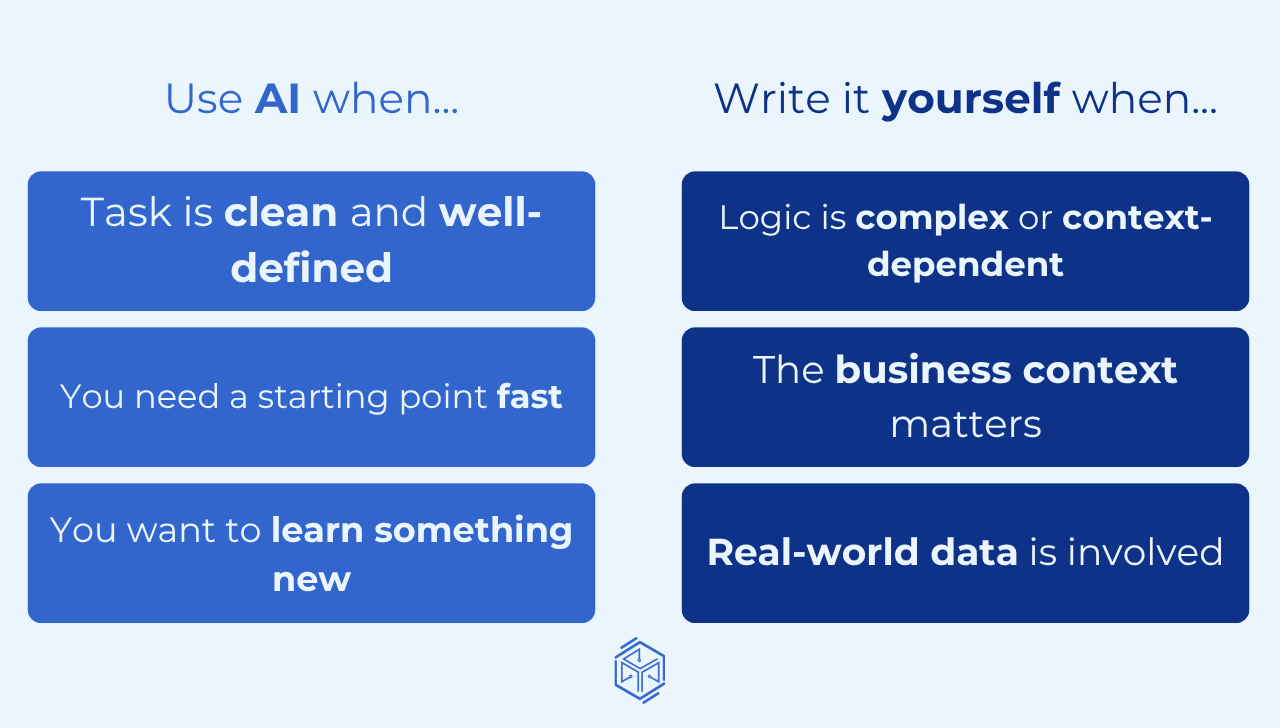
Use AI for the first draft, not the final answer. Let it write the query, then read it before you run it. Does the join make sense? Are the filters right? AI gets you started faster, , but the read-through is on you.
Write it yourself when things get messy. Multiple joins, window functions, logic that only makes sense if you know the business context- that's where you take over. AI is reliable when the task is clean, but real-world data usually isn't.
Use AI to learn faster, not to skip learning. Ask it to explain a query line by line, or show you a cleaner way to write something you already understand. That's AI actually making you better at the job, which is very different from AI doing the job for you.
Why technical SQL assessments aren’t going away
Almost every data analyst interview still includes a live SQL question. Not because companies are resisting AI, but because they want to see what's underneath it. Anyone can paste a prompt into an AI. The real question is whether you understand the logic well enough to recognize when the answer is wrong. That's the skill employers are hiring for, and it's the reason technical interviews haven't disappeared.
And that bar isn't going down anytime soon. If anything, the easier AI makes it to generate output, the more valuable it becomes to actually understand what you're looking at.
The Bottom Line
Here's the honest truth: AI makes you faster. SQL makes you accurate. You need both.
The people who'll do the best work in data over the next few years aren't the ones who skipped SQL because AI can write it. They're the ones who learned it properly, and then figured out how to use AI on top of that. Your judgment, your understanding of the data, your ability to catch what the model missed- that's what makes the output trustworthy. AI just helps you get there quicker.
Want to be the analyst who actually knows what the AI got wrong? Our Data Analytics & AI Bootcamp builds exactly that kind of foundation.
.jpg)


