


The Difference Between Machine Learning, Deep Learning, and Generative AI
Introduction: Defining the Technological Hierarchy
In the contemporary data science landscape, the terms Machine Learning (ML), Deep Learning (DL), and Generative AI (GenAI) are frequently utilized interchangeably in corporate marketing and media discourse. However, within computer science and software engineering, these terms represent distinct mathematical methodologies, computational architectures, and functional paradigms.
Conflating these concepts leads to technical inaccuracy and can result in misguided infrastructure investments, improper tool selection, and unrealistic project scoping for data-driven enterprises.
To conceptualize these domains accurately, they must be understood as hierarchical, nested subsets of computer science.
1. Machine learning is a specific mathematical and programmatic methodology contained entirely within the broader field of artificial intelligence.
2. Deep learning is a computationally intensive sub-discipline contained entirely within the boundaries of machine learning.
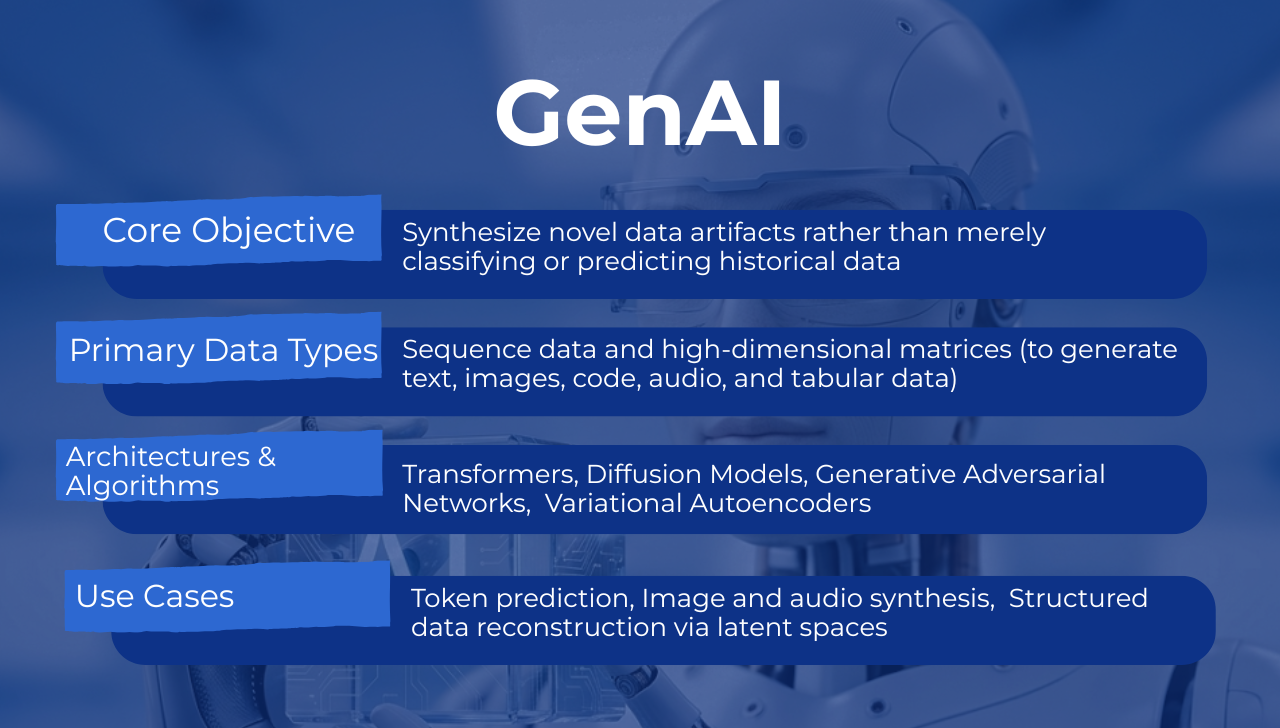
3. Generative AI represents a specialized functional subset primarily utilizing deep learning architectures to synthesize novel data artifacts rather than merely classifying or predicting historical data.
Machine Learning
Machine learning represents a fundamental mathematical paradigm shift within the overarching field of artificial intelligence.
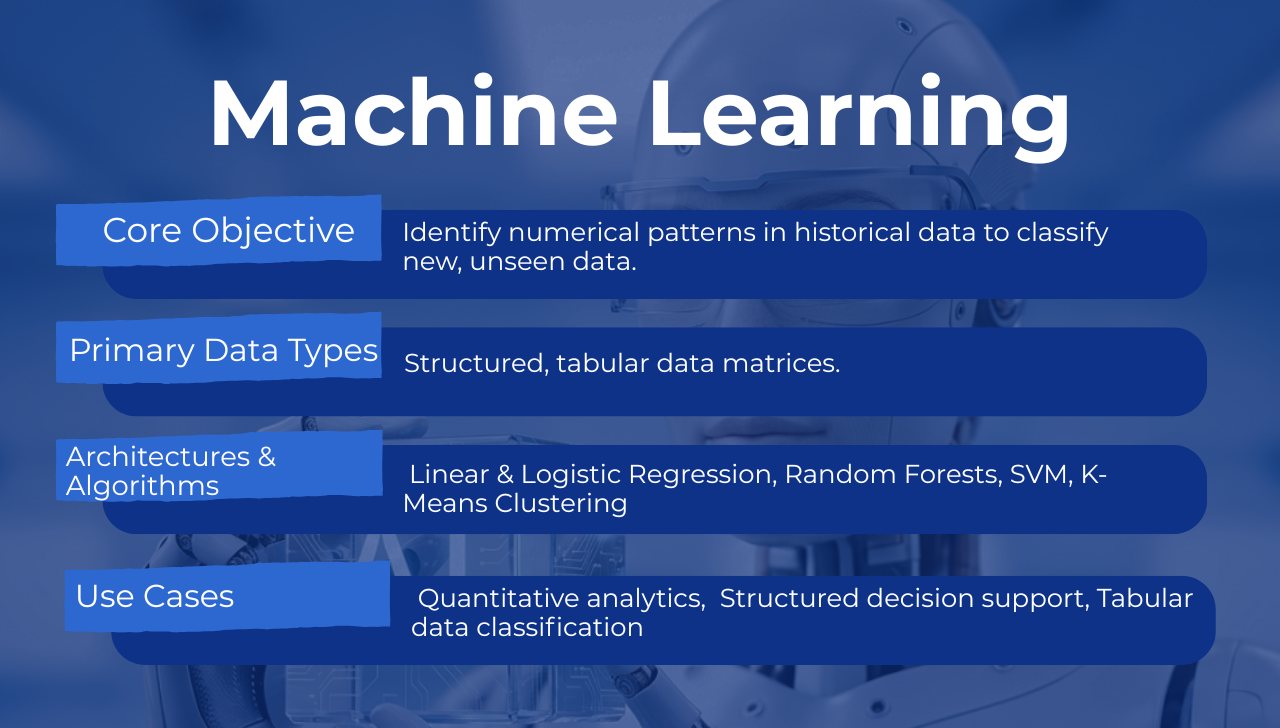
Machine learning utilizes statistical algorithms to identify numerical patterns within historical datasets. In this methodology, the computer program is supplied with input data and mathematical optimization protocols. The algorithm processes the data, calculates statistical correlations, and generates an internal computational artifact known as a model, which can then evaluate and classify new, unseen data.
The mechanics of machine learning rely on mathematical error reduction. During the training phase, the algorithm generates initial predictions, evaluates the deviation between its predictions and the actual historical outcomes using a mathematical loss function, and systematically adjusts its internal algorithmic parameters to minimize that error score over iterative computational cycles.
Machine learning methodologies are formally categorized into three primary operational frameworks:
- 1. Supervised Learning: The algorithm is trained on historical datasets containing both the input features and the corresponding verified target labels. Popular statistical algorithms include Linear Regression, Logistic Regression, Support Vector Machines, and Random Forests.
- 2. Unsupervised Learning: The algorithm analyzes datasets containing only input features without historical target labels. Its objective is to discover inherent statistical clusters, structural distributions, or data anomalies using techniques such as K-Means Clustering and Principal Component Analysis.
- 3. Reinforcement Learning: An algorithm interacts with a programmatic environment, optimizing a defined mathematical reward function through iterative trial-and-error computations and feedback loops.
A critical operational characteristic of traditional machine learning is the absolute necessity of human-directed feature engineering. Data scientists must manually analyze raw data, select the most statistically relevant variables, handle missing values, apply normalization transformations, and encode categorical data before feeding the matrix into the machine learning algorithm.
Deep Learning
Deep learning is a highly specialized subset of machine learning that utilizes complex architectures known as Artificial Neural Networks (ANNs) containing multiple sequential computational layers.
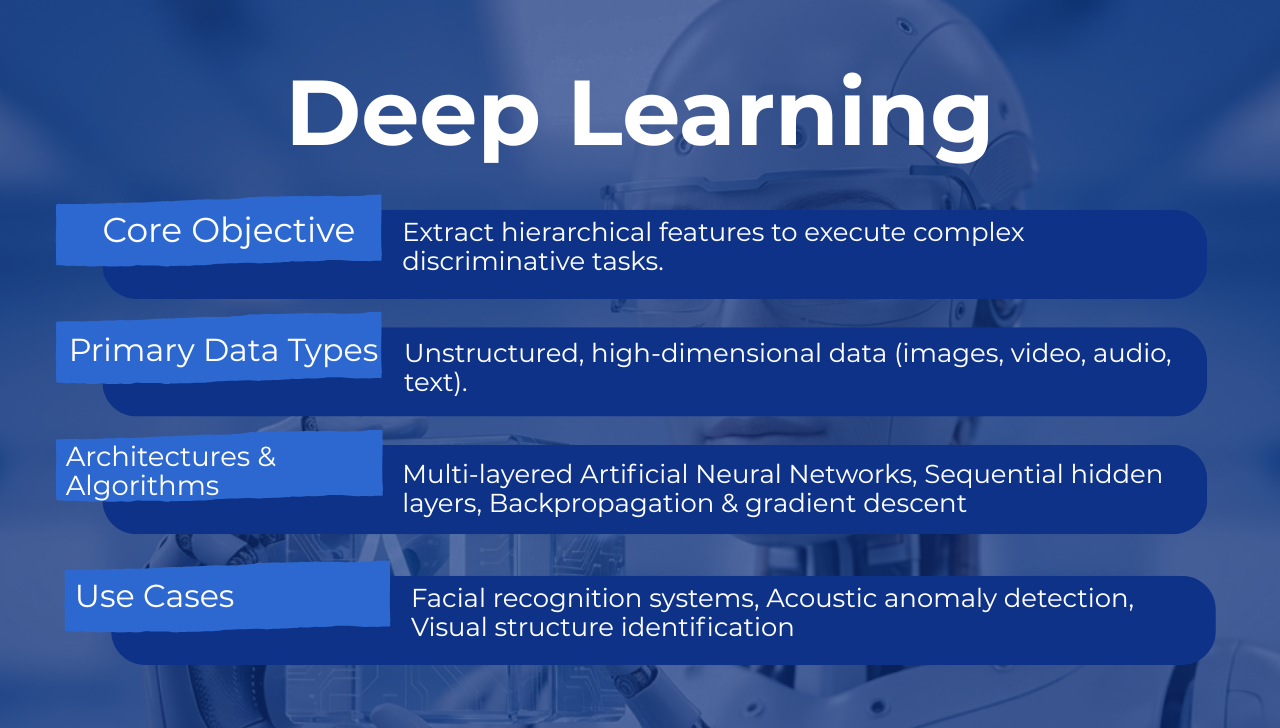
While traditional machine learning algorithms excel at processing structured, tabular data matrices, they struggle to process unstructured, high-dimensional data types such as raw video, high-resolution imagery, audio files, and extensive text corpuses without intensive manual feature engineering.
Deep learning architectures were engineered specifically to overcome this limitation by automating the feature extraction process directly from raw unstructured inputs.
Architecturally, a deep neural network consists of an input layer, an output layer, and multiple intermediate computational tiers designated as hidden layers. Each layer is composed of interconnected computational nodes.
When raw data is introduced into the input layer, each node executes a specific mathematical operation:
- 1. It multiplies the input variables by internal scalar values called weights
- 2. Adds a numerical bias term
- 3. Passes the resulting sum through a non-linear mathematical equation known as an activation function.
The numerical output of one layer immediately serves as the raw input matrix for the subsequent layer.
As data propagates through these successive sequential layers, the network constructs hierarchical statistical representations of the input data.
Generative AI
Generative AI represents a specialized functional paradigm contained primarily within deep learning and machine learning. While traditional deep learning models are predominantly discriminative generative models are engineered to approximate the underlying joint probability distribution of a training dataset.
By mathematically capturing the statistical structure of the training data, generative models can synthesize entirely novel data artifacts, such as text, images, computer code, audio, and synthetic tabular data that share the exact statistical properties of the original input corpus.
The operational foundation of modern Generative AI relies on advanced deep learning architectures designed to process sequence data and high-dimensional matrices. The most prominent architecture is the Transformer, which utilizes mathematical mechanisms called self-attention to weigh the relative statistical significance of different elements within an input sequence simultaneously, rather than processing data sequentially.
This mechanism allows Large Language Models (LLMs) to predict the most statistically probable next token (a numerical representation of a word or sub-word) across extensive text corpora.
Other critical generative architectures include Diffusion Models, which synthesize images by iteratively reversing a mathematical noise-addition process, Generative Adversarial Networks (GANs), which pit a generator network against a discriminator network in a minimax mathematical optimization game, and Variational Autoencoders (VAEs), which compress data into probabilistic continuous latent spaces for structured reconstruction.
A Comparative Synthesis of Machine Learning, Deep Learning, and Generative AI
While Artificial Intelligence encompasses the broad pursuit of automated cognition, Machine Learning, Deep Learning, and Generative AI represent nested, evolutionarily progressive mathematical paradigms. Selecting among them requires balancing predictive intent against structural complexity.
Traditional Machine Learning relies heavily on human-directed feature engineering to process structured, tabular data. It applies statistical algorithms like Random Forests to identify patterns, offering rapid training times and high mathematical interpretability for quantitative analytics.
Deep Learning eliminates manual feature engineering by utilizing multi-layered Artificial Neural Networks. This architecture extracts hierarchical features directly from high-dimensional, unstructured data, making it the mandatory choice for complex discriminative tasks like facial recognition or acoustic anomaly detection.
Generative AI shifts the objective from classification to synthesis. Utilizing advanced deep learning architectures like Transformers and Diffusion Models, GenAI maps the joint probability distribution of vast datasets to generate entirely novel text, images, or code.
To equip professionals with the precise technical competencies required across this technological spectrum, Big Blue Data Academy provides specialized curricula tailored to distinct industry roles.
The Data Science & AI Bootcamp focuses on statistical methodology, data preprocessing, and the implementation of traditional machine learning and deep learning models for predictive analytics and structured decision support.
Concurrently, the AI Engineering Bootcamp is structured around the computational infrastructure, scalable deployment pipelines, and advanced integration of deep neural networks and Generative AI foundation models into production software environments.
By aligning educational pathways with these specific architectural boundaries, students acquire the exact programmatic and mathematical skills necessary to architect robust, enterprise-grade data solutions
.jpg)


