


Understanding Flask: The Missing Link in Data Science
What is Flask?
Flask is a web application framework written in the Python programming language. It is classified specifically as a micro-framework. The term "micro" indicates that the framework does not require particular tools or external libraries to function. It lacks a built-in database abstraction layer, form validation systems, or any other components where pre-existing third-party libraries provide common functions. Instead, Flask provides the essential core mechanisms required to route web requests and render web pages, while allowing the developer to retain complete control over the structural decisions of the application.
The framework operates on two primary dependencies:The Werkzeug Web Server Gateway Interface (WSGI) utility library and the Jinja2 template engine.
1. Werkzeug manages the low-level interactions between the web application and the web server, handling data formatting, request routing, and error management.
2. Jinja2 processes dynamic content by combining static HTML templates with dynamic data passed from the Python application code.
Because Flask is completely unopinionated about data storage and architecture, developers must explicitly code or import libraries for every structural requirement beyond basic routing. This minimal core architecture ensures that the application only loads and executes the specific code written or explicitly included by the developer, preventing unnecessary processing overhead associated with unused built-in features.
Where is Flask used?
Flask is primarily used for developing RESTful APIs, microservices, and specialized web applications. In the specific context of data science, Flask is utilized as the primary mechanism for deploying trained machine learning models into production environments. Data scientists typically write their data processing pipelines and machine learning algorithms using Python libraries such as pandas, scikit-learn, frequently used for tasks such as building forecasting models or analyzing consumer data.
However, a trained model existing solely within a local Python script cannot be accessed by external software applications or end-users.
Flask resolves this limitation by wrapping the machine learning model in a web service. The framework allows the developer to define specific URL endpoints. When an external application, such as a web dashboard or a mobile application, sends an HTTP request containing input data to this endpoint, Flask intercepts the request. It extracts the input data, passes it to the pre-loaded machine learning model within the server memory, executes the prediction function, and formats the resulting prediction output as a JSON response. This JSON response is then transmitted back to the requesting application. Data scientists use Flask because it is written in the exact same programming language (Python) as their data models, requiring minimal translation of code and allowing direct integration of data processing libraries without architectural conflicts.
Features of Flask
The core feature set of Flask focuses on request handling and application configuration. It includes a built-in development server and a fast debugger. The development server allows developers to test their application locally on their machines without needing to configure a full production web server like Nginx or Apache. The integrated debugger provides detailed, literal error tracebacks directly within the browser when an exception occurs in the code, which accelerates the fault isolation process.
Flask features RESTful request dispatching, meaning it can map specific URL patterns to designated Python functions (known as view functions) and differentiate between HTTP methods such as GET, POST, PUT, and DELETE. It incorporates the Jinja2 templating system, which evaluates variables and control structures (like loops and conditional statements) directly within HTML files before the server sends the final document to the client.
Furthermore, Flask provides support for secure cookies, enabling the application to establish user sessions and store cryptographic signatures to prevent client-side modification of session data. It is fully Unicode-based, ensuring that text data from diverse languages and character sets is processed and rendered correctly without encoding errors. Finally, Flask is designed to be highly extensible; it provides specific hooks and application contexts that allow external packages to integrate securely with the core application lifecycle.
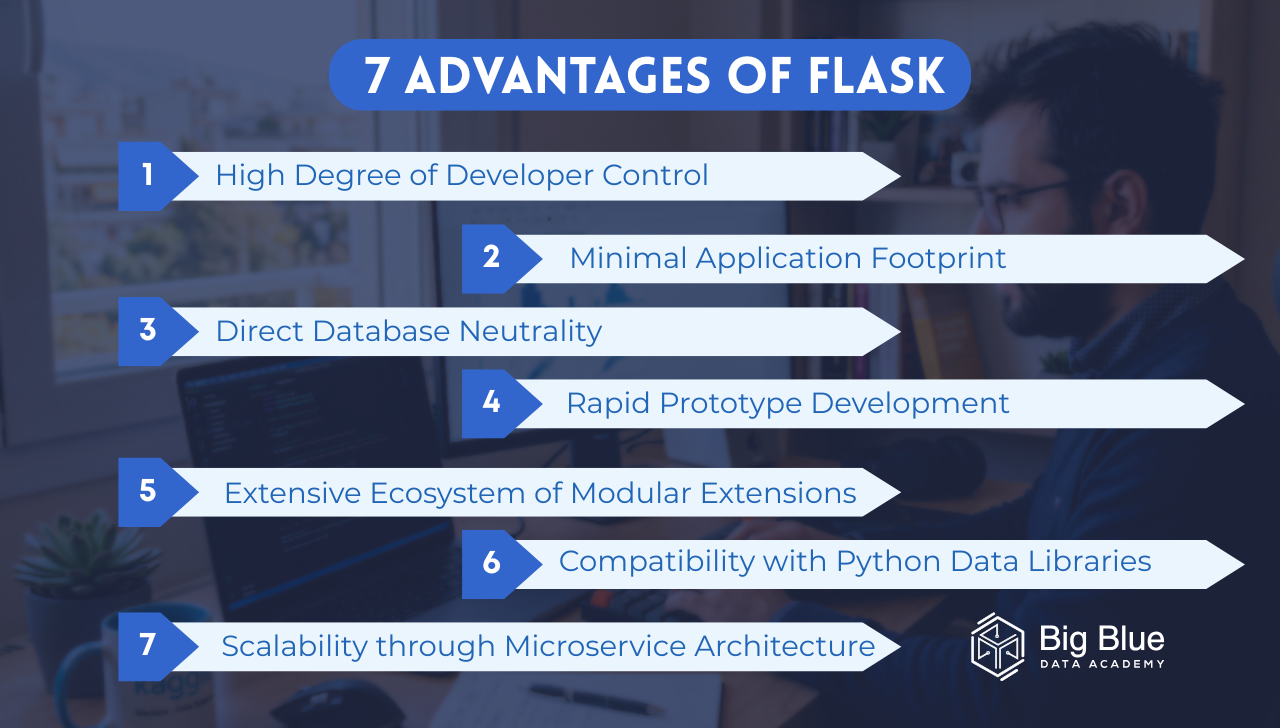
7 Advantages of Flask
1. High Degree of Developer Control: Flask does not enforce a specific directory structure or architectural pattern. Developers must manually design the application layout, allowing them to optimize the structure precisely for the operational requirements of the project.
2. Minimal Application Footprint: Because the core framework lacks built-in modules for databases or user authentication, the baseline memory and storage requirements are exceptionally low, which reduces server resource consumption.
3. Direct Database Neutrality: Developers are not restricted to a specific relational or non-relational database standard. They can integrate SQLAlchemy for SQL databases, PyMongo for MongoDB, or avoid database connections entirely if the application only processes in-memory data.
4. Rapid Prototype Development: The minimal setup requirement allows developers to initiate a functioning web server and create operational endpoints within a single Python file containing fewer than ten lines of code.
5. Extensive Ecosystem of Extensions: When additional functionality is required, developers can install specific Flask extensions (e.g., Flask-Mail for email operations, Flask-Cors for cross-origin requests) independently, ensuring the application only includes necessary code.
6. Compatibility with Python Data Libraries: The framework runs standard Python code without abstraction layers, meaning complex arrays, dataframes, and matrix operations from data science libraries execute exactly as they do in local scripts.
7. Scalability through Microservices: Instead of building a single large application, developers can deploy multiple independent Flask applications, each handling a specific function or a single machine learning model. These separate services can scale independently based on individual traffic demands.
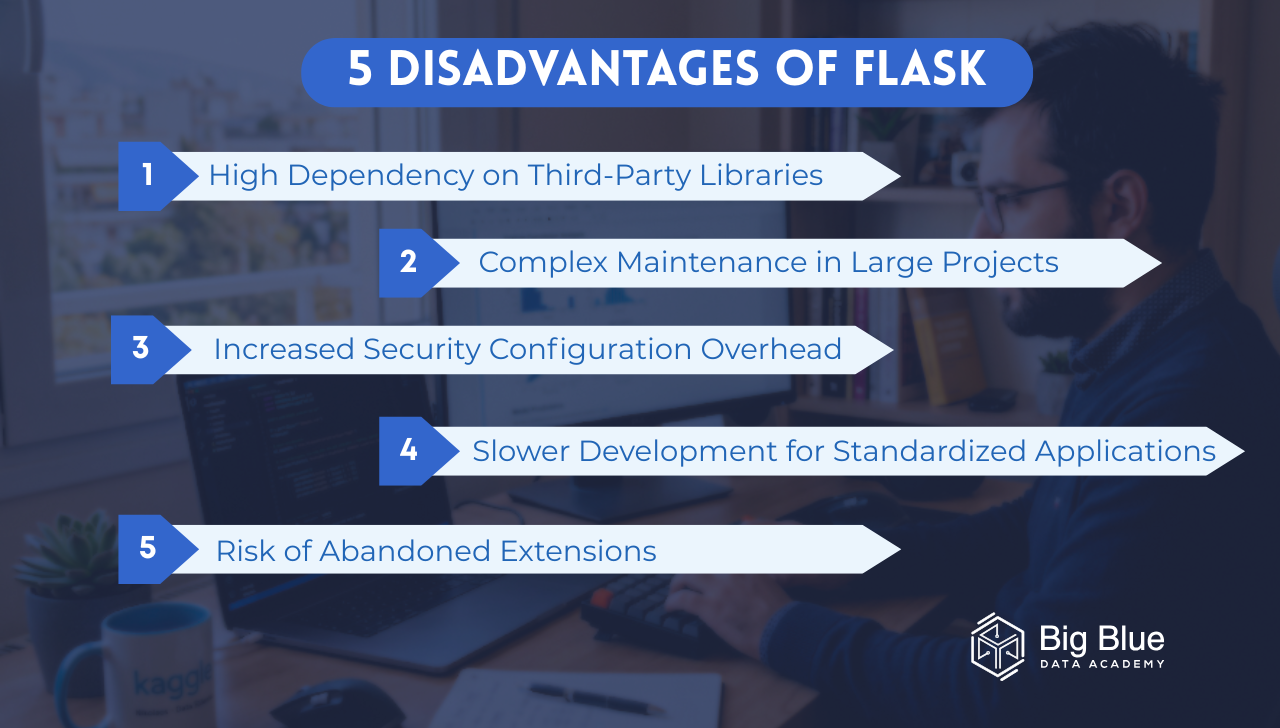
5 Disadvantages of Flask
1. High Dependency on Third-Party Libraries: To achieve standard web application functionality, such as user authentication or form validation, developers must research, select, install, and configure multiple external libraries, transferring the responsibility of feature integration entirely to the development team.
2. Complex Maintenance in Large Projects: Because Flask does not enforce a standardized file structure, large applications with hundreds of routes can become disorganized. New developers joining a project must spend considerable time learning the specific, custom architecture chosen by the original author.
3. Increased Security Configuration Overhead: Security features such as Cross-Site Request Forgery (CSRF) protection and SQL injection prevention are not enabled by default for all operations. The developer must manually implement these security measures or configure external extensions to secure the application.
4. Slower Development for Standardized Applications: If the goal is to build a standard Content Management System (CMS) or a conventional application requiring a database, user login, and an administrative interface, starting with Flask takes significantly more time because the developer must build these basic systems from the ground up.
5. Risk of Abandoned Extensions: Many Flask extensions are maintained by individual developers rather than a central organization. If an extension author ceases to update their package, the extension may become incompatible with newer versions of Python or Flask, forcing the developer to rewrite portions of their application.
How does Flask integrate with Machine Learning models?
The integration of a machine learning model into a Flask application requires a specific sequence of serialization and server-side processing. First, the model must be trained using standard data science procedures in an isolated environment. Once training is complete, the model state, including all calculated weights, decision nodes, and parameters, is serialized into a byte stream using libraries such as Pickle or Joblib. This process saves the model to a physical file (e.g., a .pkl or .joblib file) on the storage drive.
When the Flask application initializes on the server, it reads this serialized file and loads the exact state of the trained model into the active Random Access Memory (RAM). The developer then codes a specific URL endpoint using Flask’s @app.route decorator, configuring it to accept POST HTTP requests. When an external client needs a prediction, it sends a JSON payload to this endpoint containing the necessary input features. The Flask view function extracts the data from the incoming JSON, converts it into the exact data structure required by the model (such as a NumPy array or a pandas DataFrame), and calls the model’s predict() function. Finally, the function takes the numerical output generated by the model, converts it back into a standard Python dictionary, uses Flask’s jsonify function to format it into an HTTP response, and transmits the prediction back to the client.
What are the prerequisites for learning Flask effectively?
To utilize Flask effectively you must be proficient in the Python programming language. This includes a thorough understanding of Python functions, object-oriented programming concepts such as classes and inheritance, and a strong operational knowledge of Python decorators, as Flask utilizes decorators extensively to link URL routes to view functions.
Furthermore, developers must understand the fundamental mechanics of the Hypertext Transfer Protocol (HTTP). They must know the literal differences between a GET request (used to retrieve data) and a POST request (used to submit data to the server). A basic understanding of the client-server architecture is required to comprehend how web browsers interact with backend servers. Familiarity with JavaScript Object Notation (JSON) syntax is essential, as it is the standard format for transmitting data between data science APIs and client applications. Finally you must be capable of operating a command-line interface to execute Python scripts, install packages using the PIP package manager, and construct isolated virtual environments to prevent dependency conflicts between different software projects.
Is Flask taught in the data science bootcamp?
The direct answer is no. Within the structured curriculum of the data science bootcamp at Big Blue Data Academy, Flask is not included as a subject of instruction. Instead, the academy explicitly teaches Streamlit as the primary framework for the deployment of machine learning models and the creation of data-driven web applications. The decision to select Streamlit over Flask for the bootcamp environment is based on the specific operational requirements and skill optimization of data scientists.
As established in the prerequisite requirements for Flask, developing a functional web application with Flask necessitates a fundamental understanding of HTTP protocols, client-server architecture, and frontend markup languages such as HTML and CSS.
Streamlit eliminates these requirements entirely. It operates as an open-source Python library designed specifically for machine learning and data science teams. With Streamlit, developers write standard Python scripts, and the framework automatically renders the corresponding user interface elements, interactive widgets, and data visualizations directly in the web browser.
This architectural difference means that bootcamp students do not need to divert their time toward learning frontend web development or API routing syntax.
By utilizing Streamlit, students can execute the deployment phase of their data science projects by integrating their trained models directly into interactive web dashboards using purely Python code. Furthermore, Streamlit natively supports continuous execution and automatic state management, which allows data scientists to rapidly prototype visual interfaces for data exploration, parameter adjustment, and real-time model prediction output. While Flask remains a highly effective tool for constructing standalone Application Programming Interfaces and complex microservices in traditional software engineering, Streamlit provides a more direct, efficient, and specialized deployment mechanism that aligns strictly with the core competencies and workflows taught in the data science bootcamp.
.jpg)


