


The Most In-Demand Technologies to Learn in 2027
In 2027, technology skills will increasingly be defined by how effectively professionals can solve real problems. Businesses are investing in artificial intelligence, modernizing their data infrastructure, automating operations, and building digital products that can adapt to changing demands. As these investments move from experimentation to implementation, the demand for people who understand how to turn technology into measurable business value continues to evolve.
For anyone planning their next career move, choosing what to learn requires looking beyond trending tools. The most valuable technologies are those that address real industry challenges and create opportunities across different sectors. From healthcare and finance to retail, manufacturing, and professional services, the following technology areas are shaping the way organizations operate and the skills they need for the future.
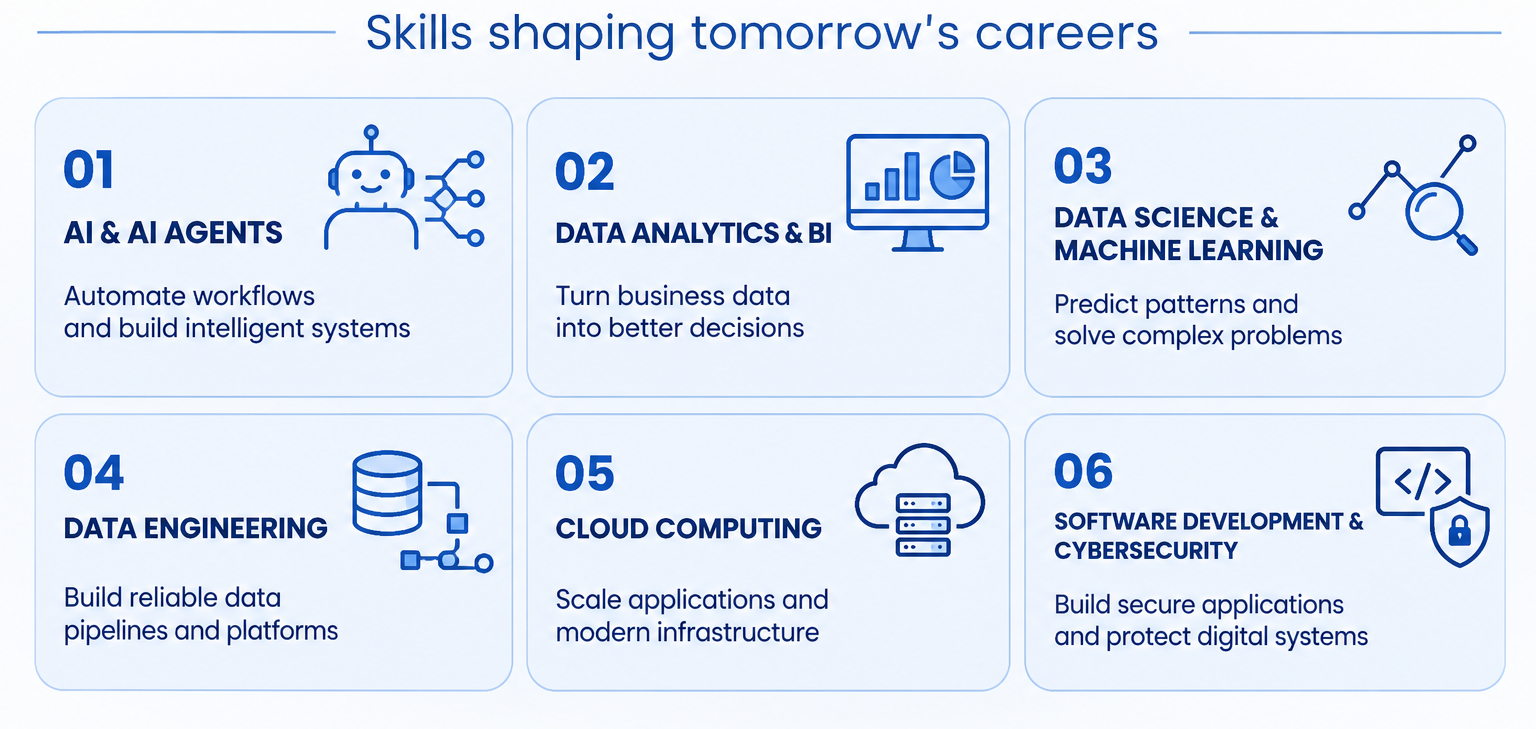
1. Artificial Intelligence and AI Agents
Artificial Intelligence is moving deeper into business operations. Companies are exploring ways to automate processes, support employees, personalize customer experiences, and make faster decisions. The next stage of AI adoption increasingly involves systems that can handle multi-step tasks, use tools, retrieve information, and interact with business applications.
Consider customer service. An AI-powered system can analyze a customer's request, retrieve relevant information from a knowledge base, identify the appropriate solution, and assist with processing an order or escalating a complex issue. In marketing, AI can support campaign research, audience analysis, content workflows, and performance reporting. In finance, AI-assisted systems can help review documents, identify anomalies, and streamline repetitive administrative tasks.
As businesses explore these applications, understanding how AI systems work becomes increasingly valuable. Professionals should develop knowledge of Generative AI, Large Language Models (LLMs), prompt engineering, retrieval-augmented generation (RAG), AI agents, workflow automation, and AI evaluation. Equally important is understanding where human oversight is needed, how to assess output quality, and how to use AI responsibly.
2. Data Analytics and Business Intelligence
Every business decision involves uncertainty. Which products should a retailer stock? Which marketing channels generate the most profitable customers? Where are operational bottlenecks affecting performance? Data Analytics helps organizations answer these questions by turning raw information into evidence that supports better decisions.
In retail, analysts combine sales, inventory, customer, and seasonal data to identify purchasing patterns and forecast demand. A business can use these insights to reduce stock shortages, avoid overstocking, and adjust pricing strategies. In digital marketing, data professionals analyze customer acquisition costs, conversion rates, and campaign performance to understand which activities deliver the strongest return on investment.
Business Intelligence takes this analysis further by making insights accessible through dashboards, reports, and visualizations. Decision-makers can monitor performance indicators, identify changes, and act without having to interpret complex datasets themselves.
SQL, data visualization, Python, statistical thinking, and tools such as Power BI are valuable foundations. However, the ability to ask the right questions, interpret findings, and communicate insights clearly is what makes analytics impactful.
3. Data Science and Machine Learning
While Data Analytics helps explain what has happened and why, Data Science and Machine Learning can help predict what may happen next and support decisions at scale.
In banking, machine learning models can analyze transaction patterns to identify potentially fraudulent activity. In healthcare, predictive models can help identify patients who may require additional attention, supporting clinical teams in prioritizing resources. In manufacturing, sensor data can be used to predict equipment failures before they disrupt production, reducing downtime and maintenance costs.
These applications rely on professionals who understand how to prepare data, select appropriate algorithms, train models, evaluate performance, and monitor their behavior over time. Python, statistics, machine learning, feature engineering, model evaluation, and increasingly deep learning form an important part of this skill set.
As AI becomes more accessible, the ability to distinguish a useful model from an unreliable one becomes especially important. Understanding data quality, bias, accuracy, and the limitations of predictions helps organizations deploy machine learning systems with greater confidence.
4. Data Engineering: The Infrastructure Behind AI
AI applications and analytical systems depend on data that is accessible, accurate, consistent, and available when needed. Behind many successful data and AI initiatives lies a complex infrastructure that collects information from multiple sources and transforms it into something organizations can use.
Imagine an international retailer combining information from hundreds of stores, its e-commerce platform, customer loyalty systems, suppliers, and logistics partners. Without reliable pipelines and scalable infrastructure, its analysts may work with incomplete information, its forecasting models may produce unreliable results, and business teams may struggle to get a consistent view of performance.
Data Engineers solve these challenges by building and maintaining the systems that move and process data. They work with data pipelines, databases, distributed systems, data warehouses, and cloud-based platforms to make information dependable and accessible.
SQL, Python, ETL/ELT processes, data modeling, orchestration, and technologies for large-scale data processing are essential areas to explore. As organizations expand their AI capabilities, Data Engineering is becoming increasingly important to the successful deployment and scaling of AI solutions.
5. Cloud Computing and Modern Infrastructure
Developing an application, training a machine learning model, or processing millions of records requires infrastructure. Cloud Computing gives organizations access to computing resources, storage, databases, and services without having to build and maintain every component of their own physical infrastructure.
For example, a startup can launch a digital product without investing in its own data center. A global company can scale its computing resources during periods of high demand. A Data Science team can access specialized infrastructure for model training, while Data Engineers can build cloud-based pipelines that process information from multiple sources.
Cloud platforms also provide services for AI, analytics, application development, security, and data management. Learning cloud fundamentals, architecture, networking, storage, access management, and deployment can therefore complement a range of technical career paths.
Familiarity with platforms such as AWS, Microsoft Azure, or Google Cloud can be valuable, but understanding how to design reliable, secure, scalable, and cost-efficient systems is the more transferable skill.
6. Software Development, Automation, and Cybersecurity
Software development is changing as AI coding assistants help developers generate code, debug problems, write tests, and accelerate repetitive tasks. This is creating new possibilities for building applications and automating business workflows, including solutions tailored to specific operational needs.
For example, a logistics company may develop an application that connects shipment information, automatically flags delays, and notifies the relevant teams. A business may automate internal approval processes or build a tool that consolidates information from different platforms. AI-assisted development can accelerate these workflows, while programming fundamentals, APIs, testing, debugging, and system design remain essential for producing dependable software.
At the same time, greater digital connectivity and AI adoption introduce new security challenges. Organizations must protect sensitive information, control access, secure cloud environments, and assess vulnerabilities in applications and AI systems. Cybersecurity knowledge is therefore becoming relevant not only to dedicated security teams but also to developers, cloud engineers, and professionals working with data.
Understanding secure coding practices, identity and access management, data privacy, risk assessment, and AI security can help professionals build and operate technology more responsibly.
How to Choose the Right Technology to Learn in 2027
The best technology to learn depends on the type of problems you enjoy solving and the career you want to pursue. If you are interested in business performance, customer behavior, and decision-making, Data Analytics or Business Intelligence can provide a strong starting point. If you enjoy programming, mathematical problem-solving, and building predictive systems, Data Science or Machine Learning may be a better fit.
Those interested in infrastructure, systems, and large-scale data processing may find Data Engineering and Cloud Computing particularly rewarding. If you want to build applications or automate processes, Software Development and AI Engineering offer opportunities to combine technical foundations with emerging AI capabilities.
Regardless of your chosen direction, learning through practical projects is essential. Working with real datasets, developing applications, experimenting with AI workflows, and solving realistic business problems helps turn theoretical knowledge into demonstrable skills.
Prepare for the Opportunities Ahead
The technologies shaping 2027 are creating new opportunities across industries and career paths. The professionals best positioned to benefit will be those who combine technical knowledge with analytical thinking, adaptability, communication, and the ability to apply what they learn to real-world challenges.
At Big Blue Data Academy, our bootcamps and courses help learners build these capabilities through structured training, hands-on projects, and industry-focused learning paths. Whether you are looking to enter the tech industry, transition into a new role, or strengthen your existing skill set, there is a learning path to help you take the next step.
Explore Big Blue Data Academy's bootcamps and courses and start building the skills for your next opportunity.


